

Formal vs. Informal Employment: How Job Types Influence Poverty Reduction
A World Bank study finds that shifts into upper-tier informal wage jobs significantly reduce poverty at lower thresholds, while formal wage employment is crucial for poverty reduction at higher income levels. The creation of these jobs, however, requires targeted policies beyond improvements in education and urbanization.
 CoE-EDP, VisionRI
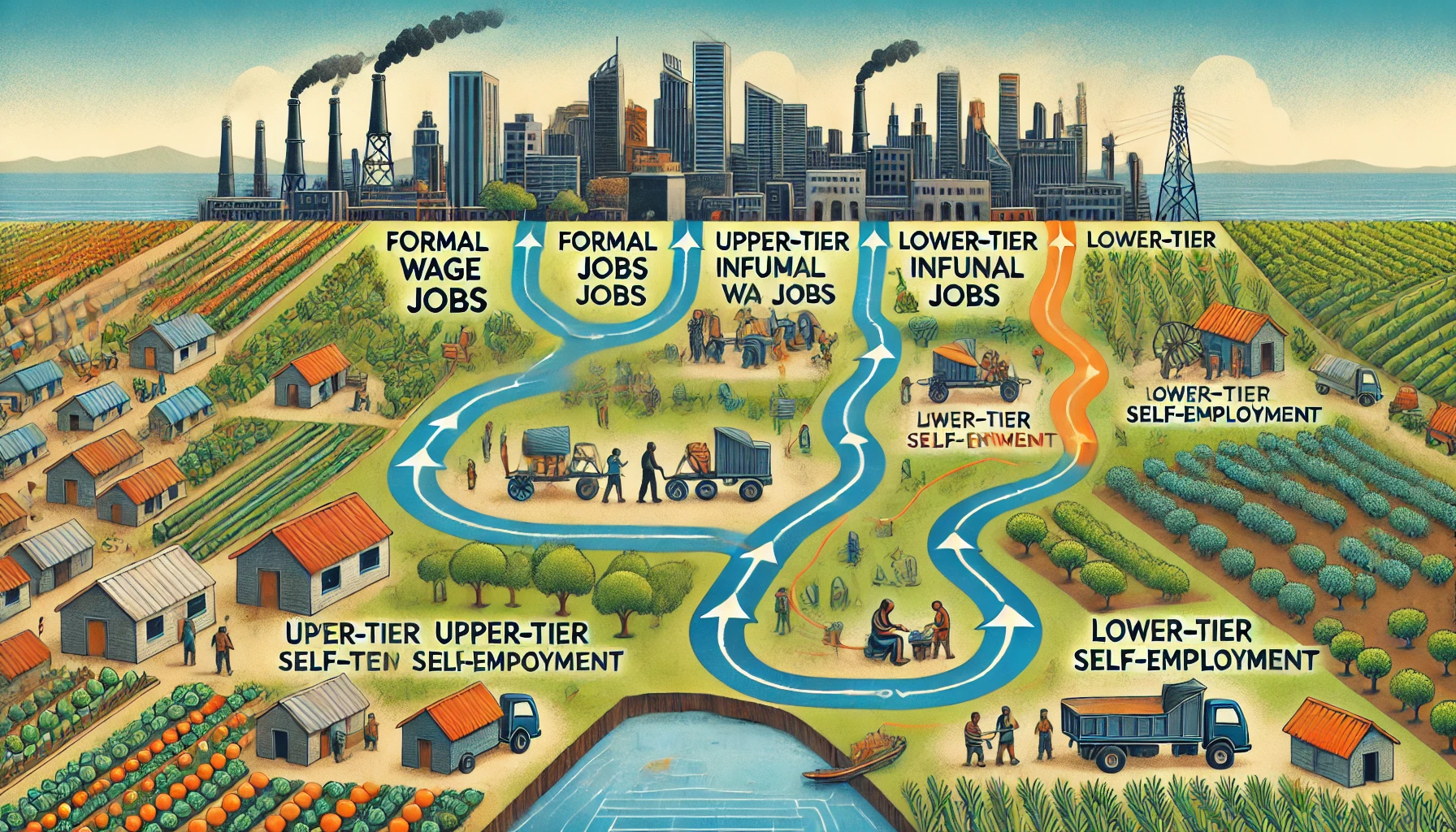
A new study from the World Bank explores the relationship between job type changes and poverty reduction in an unbalanced panel of 89 countries over the past 30 years. The research classifies jobs into five categories: formal wage jobs, upper-tier informal wage jobs, lower-tier informal wage jobs, upper-tier self-employment, and lower-tier self-employment. Key findings from the study indicate that net shifts into upper-tier informal wage jobs, such as professionals, managers, technicians, or clerks, from lower-tier informal jobs, are strongly associated with poverty reduction at the 1.90 dollar and 3.20 dollar poverty lines. However, transitions from lower-tier informal jobs to formal wage jobs are associated with only modest poverty reductions at the 5.50 dollar poverty line. The study highlights that only a small fraction of the workforce less than 2 percent is engaged in upper-tier informal wage jobs, with minimal growth observed over the past three decades in low- and middle-income countries.
The Impact of Job Shifts on Poverty Reduction
Interestingly, the findings show that increases in upper-tier informal wage jobs are associated with shifts of the workforce from microenterprises to small firms in lower- and upper-middle-income countries, but not with higher educational attainment or urbanization. In contrast, increases in the share of formal wage jobs are strongly associated with increases in the share of workers with post-secondary education, particularly driven by high-income countries. This suggests that while upper-tier informal wage jobs and the skills they require play a potentially important role in poverty reduction, they are not automatically generated by increased educational attainment, urbanization, or firm size. The study also emphasizes that formal wage employment has increased on average in the past 30 years, especially since the turn of the century, driven mostly by high-income countries and more pronounced among men. However, the four informal job categories do not show a consistent trend over the same period.
Education and Firm Size: Key Drivers of Job Quality
The research provides a nuanced understanding of the relationship between job types and poverty reduction. It shows that while upper-tier informal wage jobs can significantly reduce poverty, they are not being created at a sufficient rate in developing countries. This highlights the importance of targeted policies that can facilitate the creation of such jobs. For instance, the study finds that improvements in higher education are strongly associated with shifts out of lower-tier informal jobs to formal wage jobs, but improvements in basic education levels are not statistically significant. Firm size also plays a role in job quality, with increases in the share of workers employed in small firms (with six to 20 employees) significantly correlated with increases in upper-tier informal wage employment and lower-tier informal jobs. An increase in larger firms, defined as more than 20 employees, is also associated with a shift out of lower-tier self-employment into formal wage work, though this is only marginally statistically significant.
Country Characteristics and Labor Reallocations
The study explores various country characteristics associated with labor reallocations to pro-poor informal upper-tier jobs and formal wage jobs. It finds that urbanization does not have a significant impact on movements up the job ladder to formal and informal upper-tier jobs, while labor reallocations from agriculture to manufacturing are associated with increases in formal wage employment. Moreover, there are no clear relationships between educational attainment, urbanization, or firm size and net shifts into the informal upper-tier wage jobs that are most conducive to poverty reduction. This suggests that further research is needed to better understand the country-level conditions that promote growth in the types of jobs most conducive to poverty reduction.
The Complexity of Labor Reallocation
The findings from this study highlight the complexity of labor reallocation and its impact on poverty reduction. While formal wage employment has generally increased, driven by high-income countries, the creation of upper-tier informal wage jobs has been minimal. This indicates that simply improving education or urbanization may not be sufficient to generate the types of jobs needed for significant poverty reduction. Instead, a more targeted approach that includes facilitating the growth of small firms and improving access to upper-tier informal wage jobs may be necessary.
Targeted Policies for Meaningful Poverty Reduction
The World Bank study sheds light on the important role of job types in poverty reduction. It underscores that while upper-tier informal wage jobs are crucial for reducing poverty at lower income levels, formal wage employment becomes more important at higher income thresholds. The study calls for targeted policies to create and promote such job opportunities, particularly in developing countries, to achieve meaningful poverty reduction. This comprehensive analysis of job types and their impact on poverty reduction provides valuable insights for policymakers aiming to design effective labor market interventions.
- FIRST PUBLISHED IN:
- Devdiscourse
ALSO READ
-
World Bank Backs Serbia’s Gas Network With $600M for Decade of Energy Upgrades
-
World Bank Backs Türkiye’s Farmers With $750 M to Boost Rural Jobs and Growth
-
Machine Learning Reveals Why Women’s Agency Measures Must Reflect Local Realities in Tunisia
-
Malawi’s Fragile Recovery Faces Jobs Test; Debt and State Firms Strain Economy
-
Ethiopia’s Justice Paradox: Fast Courts Face Staffing, Digital and Access Gaps as Cases Rise


 Google News