

World Bank’s Plan to Boost Africa’s Blue Economy and Restore Coastal Biodiversity
The World Bank’s Blue Economy brief urges urgent action to protect Africa’s coastal and marine ecosystems, which are vital for jobs, food security, and climate resilience. It outlines innovative, data-driven solutions and investments to combat overfishing, habitat loss, and climate threats.
 CoE-EDP, VisionRI
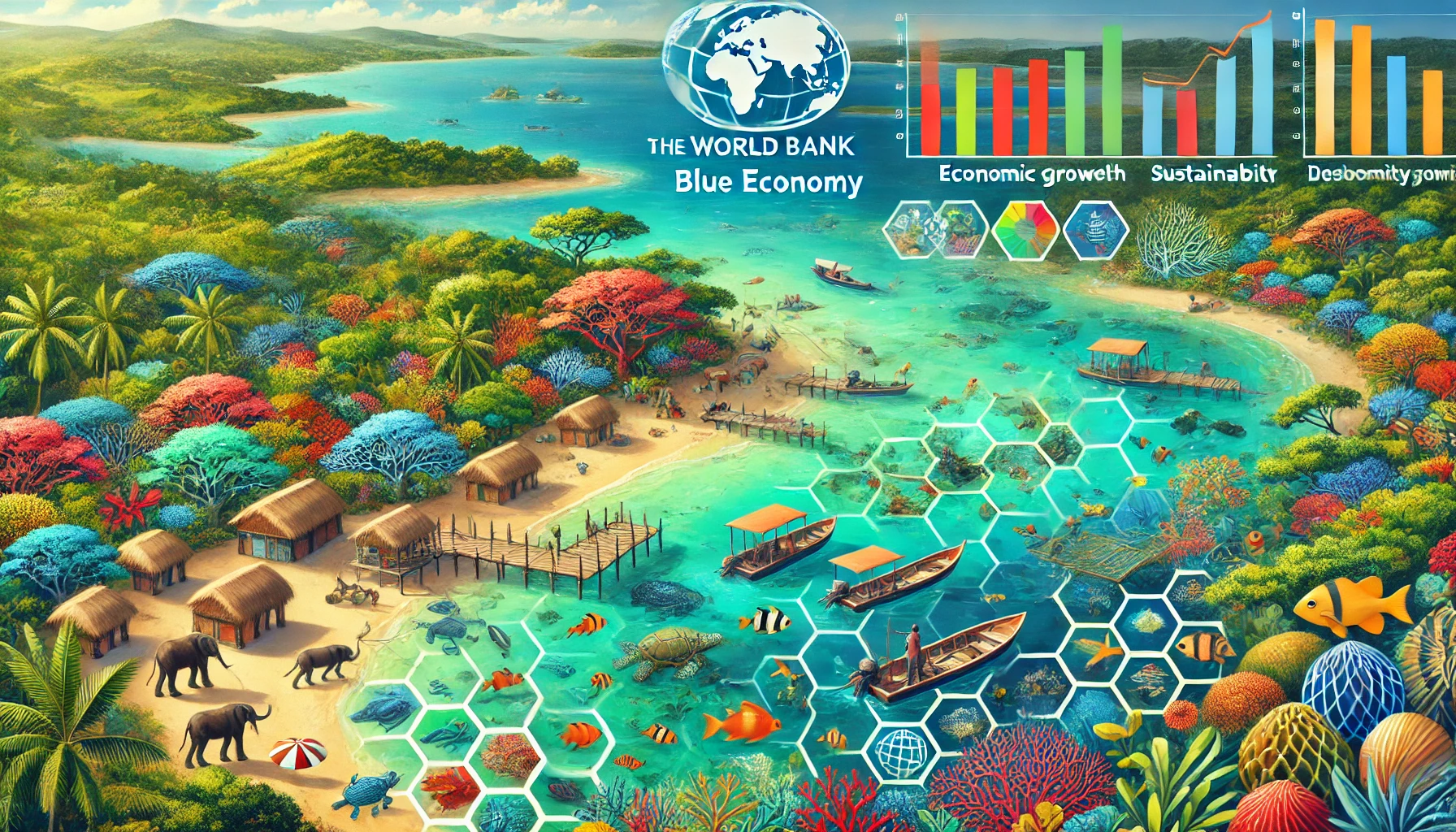
Africa's vast coastline stretching over 30,000 kilometers and brimming with mangroves, coral reefs, and seagrass meadows has long been a source of economic vitality and ecological richness. According to research by institutions like the World Bank Group, PROBLUE, the European Marine Spatial Agency, and the WAVES partnership, these coastal ecosystems underpin a Blue Economy that generated nearly $300 billion and supported 49 million jobs across Africa in 2018 alone. But this natural capital is now under siege. Coastal degradation, overfishing, habitat destruction, marine pollution, and climate change are rapidly eroding the continent's ecological base. With fisheries alone contributing $24 billion annually, the stakes are high not only for national economies but for the millions who depend on the ocean for food security and livelihoods.
Mangroves are being stripped for firewood and cleared for urban development. Coral reefs are bleaching under rising sea temperatures and ocean acidification, threatening vital fish habitats. Coastal erosion is accelerating, with countries like Senegal, Togo, and Côte d'Ivoire losing nearly two meters of shoreline each year. Climate change is expected to exacerbate these trends, potentially reducing global fish catch potential by 7.7 percent by 2050, with West Africa among the hardest hit regions. Without urgent action, Africa's marine biodiversity—home to eight of the world's 36 biodiversity hotspots, could face irreversible decline.
The Knowledge Gap Blocking Progress
A major barrier to action is a lack of reliable data. Too little is known about the current status of marine species essential to Africa's Blue Economy, including commercially valuable fish like yellowfin tuna, as well as ecotourism drivers like whales, dolphins, and turtles. Weak monitoring capacity and fragmented marine governance have left Exclusive Economic Zones vulnerable to illegal, unregulated, and unreported (IUU) fishing. The result is a hemorrhaging of blue capital from African waters.
To confront these challenges, the World Bank emphasizes the need for robust marine spatial planning and stronger inter-agency coordination. This involves updating environmental regulations, improving coastal urban planning, and designating protected marine zones. However, currently only 16.9 percent of Africa's marine areas are formally protected, well short of the post-2020 Global Biodiversity Framework target of 30 percent. Local and national governments must also invest in building the institutional capacity to monitor marine biodiversity, control invasive species, and enforce environmental regulations.
Turning Policy into Action
The World Bank is backing a wave of reforms and projects that link policy development with on-the-ground interventions. In Mozambique, the 2020 Marine Fisheries Regulations, developed with World Bank support under the SWIOFish program, established co-managed conservation zones in biodiversity hotspots such as Moma and Pebane. Tanzania's war against blast fishing, once widespread, is another success story. Backed by World Bank funding, improved surveillance has driven down the use of explosives in fishing, while coral reef monitoring systems now support marine protected area management.
In Morocco, a Blue Economy Program for Results is restoring over 15,000 hectares of coastal forest, stabilizing 1,060 hectares of sand dunes, and developing biodiversity plans across ecologically sensitive coastal zones. Scientific monitoring of coastal water quality, sedimentation, and fish stocks is being scaled up to inform climate adaptation strategies. Meanwhile, in Kenya, mangrove restoration efforts in Lamu, Kilifi, and Kwale counties are being driven by local communities, many of them women trained and equipped through World Bank-supported programs.
Innovation and Investment Driving Change
Modern tools are reshaping how Africa manages its marine environment. Kenya is adopting DNA-based biodiversity tracking to rapidly assess reef health and species diversity. Through partnerships with the European Marine Spatial Agency, African countries are now accessing high-quality spatial data to track erosion, current flows, and climate impacts. The International Finance Corporation, the private sector arm of the World Bank Group, has stepped in with $70 million to install 150 ballast water treatment systems on global cargo ships, curbing the spread of invasive species such as Chilean mussels and Pacific barnacles.
In Mauritania, a nature-based project to stabilize coastal dunes in Nouakchott protects the capital from sea incursions. Benin, Togo, and São Tomé e Príncipe have rolled out grey and green infrastructure projects that restore beaches and bolster flood defenses. All of these initiatives reflect a growing recognition that nature-based solutions are not only effective but also economically smart.
A Race Against Time and Climate
Africa's push toward a resilient Blue Economy faces steep financial demands. Reversing global biodiversity loss and climate impacts will require annual investments between $598 billion and $824 billion, a tall order for a continent also grappling with land degradation, water scarcity, and rapid population growth. Yet the alternative inaction is far costlier.
The World Bank warns that if Africa is to protect its marine wealth, it must intensify investment, improve governance, and scale up local engagement, particularly of women, who are vital to community-led fisheries and restoration projects. This isn't just about preserving marine life. It's about economic transformation, climate resilience, and long-term human wellbeing. The World Bank's blueprint, backed by global research and African-led solutions, shows that a thriving Blue Economy is possible. But time is running out, and the oceans can't wait.
- FIRST PUBLISHED IN:
- Devdiscourse
ALSO READ
-
Tanzania’s Growth Gains Need Better Jobs to Bring Lasting Prosperity to More Families
-
Better Schools, Stronger Economy: Saudi Arabia Eyes a Major Growth Dividend From Education
-
World Bank’s Billion-Person Digital Push Puts Affordable Internet and AI at Center Stage
-
Tanzania’s Economy Gains Momentum, but Better Jobs Hold the Key to Broader National Prosperity
-
Tanzania’s Growing Economy Puts Better Jobs at the Heart of Its Next Growth Chapter


 Google News