

World's most powerful space telescope now ready for instrument commissioning
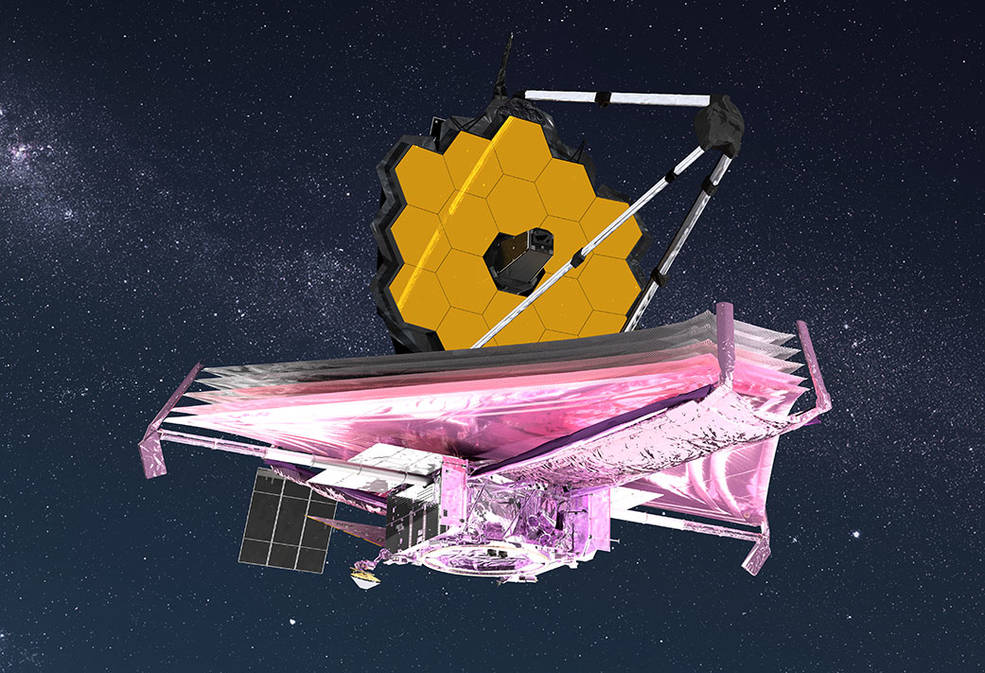
With the completion of the seventh and final stage of alignment, NASA's James Webb Space Telescope is now capable of capturing crisp, well-focused images with each of its four powerful onboard science instruments. The observatory is now ready to move forward into its next and final series of preparations, called science instrument commissioning, the agency said on Thursday.
The telescope's alignment can be seen in a series of test images that capture the world's most powerful space observatory's full field of view. For this test, Webb pointed at a part of the Large Magellanic Cloud, a small satellite galaxy of the Milky Way, providing a dense field of hundreds of thousands of stars across all the observatory's sensors.
According to NASA, the instrument commissioning process will take about two months before scientific operations begin in the summer. During this phase, the specialized characteristics of these instruments will be configured and operated in various combinations to fully confirm their readiness for science.
Instruments onboard the space telescope include:
- Near-Infrared Camera, or NIRCam - Webb's primary imager will detect light from: the earliest stars and galaxies in the process of formation, the population of stars in nearby galaxies, as well as young stars in the Milky Way and Kuiper Belt objects.
- Near-Infrared Spectrograph, or NIRSpec - It is designed to observe 100 objects simultaneously.
- Mid-Infrared Instrument, or MIRI - It will observe the redshifted light of distant galaxies, newly forming stars, and faintly visible comets as well as objects in the Kuiper.
- Fine Guidance Sensor/Near InfraRed Imager and Slitless Spectrograph, or FGS/NIRISS - It will be used to investigate first light detection, exoplanet detection and characterization, and exoplanet transit spectroscopy.
Webb is an international partnership between NASA, ESA and the Canadian Space Agency (CSA), was launched on an Ariane 5 rocket from French Guiana on December 25, 2021. The premier observatory is expected to answer outstanding questions about the Universe and make breakthrough discoveries to help humanity understand the origins of the universe. It will complement and extend the discoveries of Hubble.


 Google News