

Researchers find evidence of two water worlds that are unlike any planet found in our solar system
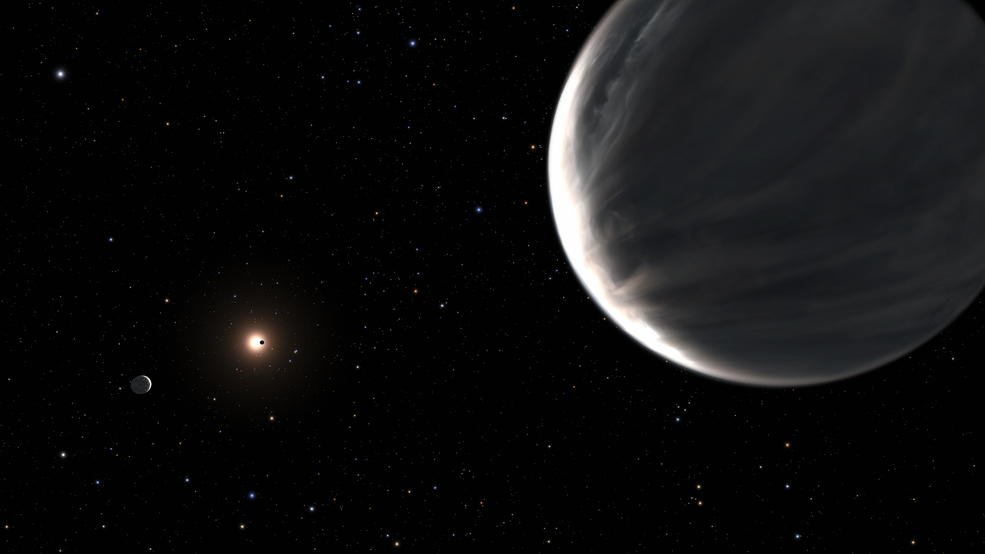
Researchers, using the Hubble Space Telescope and the retired Spitzer space telescope have found evidence that two exoplanets orbiting a red dwarf star are water worlds that are unlike any planet found in our solar system.
The newly-discovered water worlds are located in a planetary system 218 light-years away in the constellation Lyra. Both planets, Kepler-138 c and Kepler-138 d, are twice Earth's mass but have roughly half of Earth's density, and therefore cannot be solid rock, according to the researchers.
"Water wasn't directly detected at Kepler-138 c and d, but by comparing the sizes and masses of the planets to models, astronomers conclude that a significant fraction of their volume – up to half of it – should be made of materials that are lighter than rock but heavier than hydrogen or helium. The most common of these candidate materials is water," NASA said in a statement.
While the two water worlds Kepler-138 c and d have virtually the same size and mass, the closer-in planet, Kepler-138 b is confirmed to be one of the smallest exoplanets known, having the mass of the planet Mars and the density of a rock.
The team, led by Caroline Piaule of the Trottier Institute for Research on Exoplanets at the University of Montreal, have published the study of this planetary system, known as Kepler-138, in the journal Nature Astronomy.
Hubble helped find evidence of two exoplanets (planets that orbit stars beyond our Sun) where water makes up a large fraction of the entire planet.Located 218 light-years away, these exoplanets are unlike any planets in our own solar system: https://t.co/4wlPFzmSlW pic.twitter.com/wWfO9VeWDh
— Hubble (@NASAHubble) December 15, 2022
The two possible water worlds, Kepler-138 c and d, are not located in the habitable zone, a region around a star where liquid water can exist on a planet's surface. But in the Hubble and Spitzer data, researchers additionally found evidence for a new planet in the system, Kepler-138 e, in the habitable zone.
Kepler-138 e is small and farther from its star than the three others in the planetary system - takes 38 days to complete an orbit. The nature of this newly found planet, however, remains an open question as it doesn't seem to transit its host star.


 Google News