

Mysterious hidden galaxy from early universe comes into view
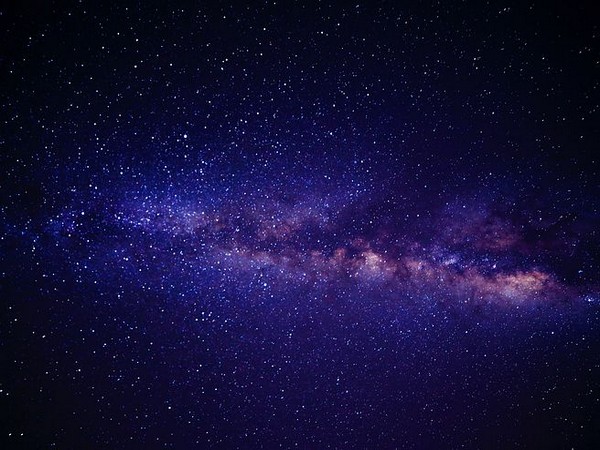
Scientists have finally succeeded in identifying the features of an extremely remote celestial body - a mysterious galaxy that hides from even the most sophisticated instruments such as the NASA/ESA Hubble Space Telescope.
A research team from Scuola Internazionale Superiore di Studi Avanzati (or SISSA), led by Prof. Andrea Lapi, was able to determine the main properties of this mysterious invisible galaxy using the ALMA interferometer in the Atacama Desert of northern Chile. They have reported their findings in The Astrophysical Journal.
The researchers utilized gravitational lensing, one of the most powerful tools for studying the distribution of dark matter, the evolution of galaxies, and other aspects of cosmology and astrophysics, to study this celestial body.
For the unversed, gravitational lensing is a phenomenon in which the gravitational field of a massive object such as a galaxy or a cluster of galaxies bends and amplifies light from an object farther behind it, leading to multiple distorted and magnified images of the background object, which can provide valuable information about both the lensing object and the background object.
"This was a very special celestial body. It is very bright and potentially subject to lensing, but this occurs only at certain precise wavelengths, probably due to the presence of large quantities of interstellar dust. Studying it is consequently very complex," said the first author Marika Giulietti, who studies Astrophysics and Cosmology at SISSA.
The observations revealed that the object is a very compact and young galaxy, forming stars at a significantly high rate, about 1000 times the rate of our Milky Way galaxy. The analysis also provided valuable insights about the gas content of this source and its distribution.
What's next?
The researchers hope that the James Webb Space Telescope (JWST) - one of the most powerful astronomical observatories ever built - will reveal much more about this peculiar galaxy.


 Google News