



NASA sending trio of miniature rovers to the Moon
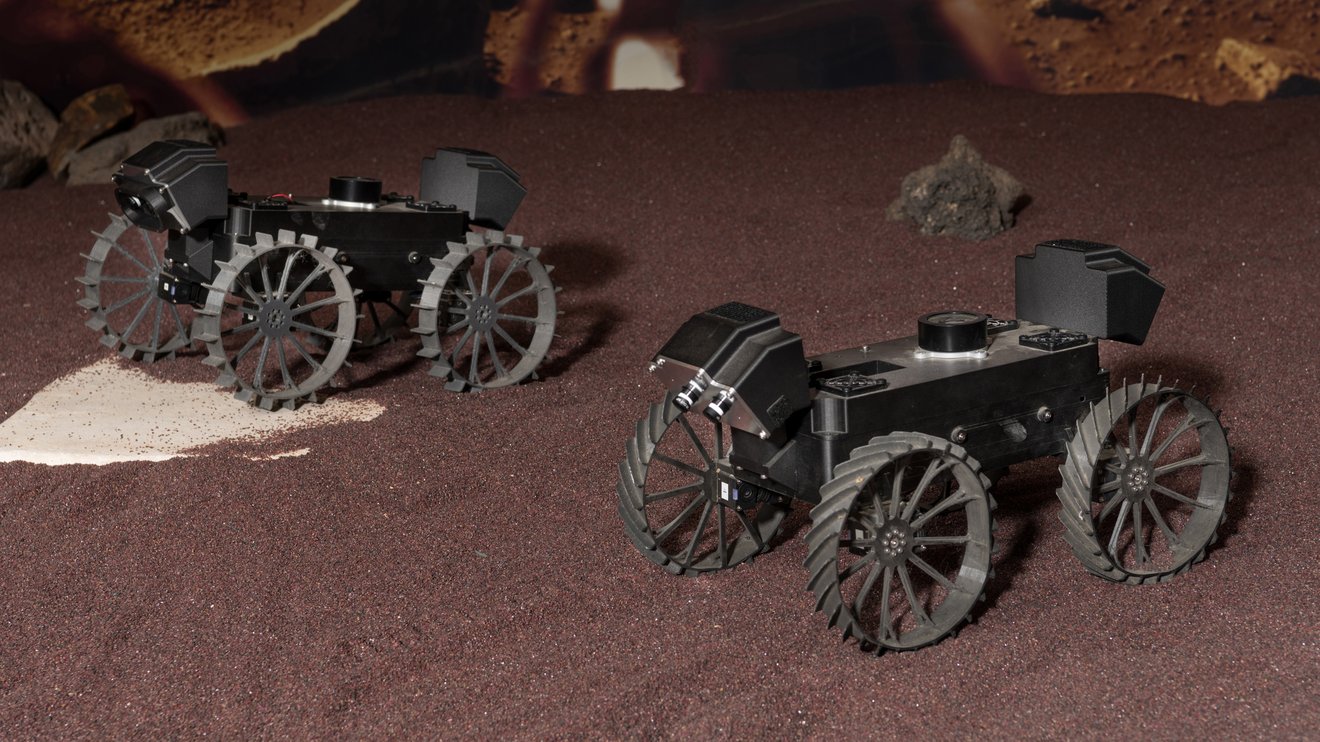
NASA is gearing up to send a trio of miniature rovers, each the size of a carry-on bag, to the Moon to test their cooperation capabilities without direct human input. The ambitious Cooperative Autonomous Distributed Robotic Exploration (CADRE) project will pave the way for the development of autonomous robots that could significantly enhance the efficiency of future space missions.
Scheduled to arrive in 2024 as part of NASA's Commercial Lunar Payload Services (CLPS) initiative, the CADRE rovers will be carefully deployed in the Reiner Gamma region of the Moon via tethers. Each rover will first find a suitable location to soak up the sunlight and recharge its solar panels. The rovers will spend an entire lunar day, equivalent to about 14 Earth days, conducting experiments designed to test their autonomous capabilities.
The mission controllers back on Earth will provide a general directive to the base station aboard the 13-foot-tall lander. Once on the Moon's surface, the miniature robotic team will elect a "leader" among themselves, which in turn will distribute work assignments to accomplish the collective objectives. Each of the four-wheeled rovers will independently determine the safest way to complete their assigned task.
A trio of mini rovers will soon be on the move – exploring cooperatively without direct human input!Landing on the Moon in 2024, @NASA’s CADRE project will demonstrate that a network of mobile robots can work together to accomplish tasks autonomously. https://t.co/ybIh8P7rxU pic.twitter.com/uR9iJY5Bcz
— NASA JPL (@NASAJPL) August 2, 2023
During the mission, the rovers will undergo several tests, all of which will be closely monitored by cameras on the base station aboard the lander. Though the primary focus of the CADRE mission is not scientific research, the rovers will be equipped with multistatic ground-penetrating radars. By driving in formation, each rover will receive reflections of radio signals sent by the others, resulting in a 3D image of subsurface structures up to 33 feet below the Moon's surface.
According to NASA, the collective data gathered from the trio of mini rovers will outperform current state-of-the-art ground-penetrating radars like the one on the agency's Perseverance Mars rover.
In addition to testing autonomy and teamwork capabilities, the rovers also need to survive the harsh thermal environment near the Moon's equator, which poses a challenge for such tiny robots. Made with a combination of commercial off-the-shelf parts and custom-built components, the rovers must endure the daytime heat while remaining lightweight and robust enough to carry out their mission.
The mission team has implemented 30-minute wake-sleep cycles for the rovers to ensure the survival of these small robots in the harsh lunar environment. Every half-hour, the rovers will shut down to cool off via radiators and recharge their batteries. When the rovers awaken, they will utilize a mesh radio network, similar to a home Wi-Fi network, to communicate with each other and share their health status updates. Thereafter, they will select a leader based on their fitness and go for another round of lunar exploration.
- READ MORE ON:
- NASA miniature Moon rovers
- NASA CADRE miniature robots


 Google News