

Astronomers measure mass of distant black hole for first time
- Country:
- Chile
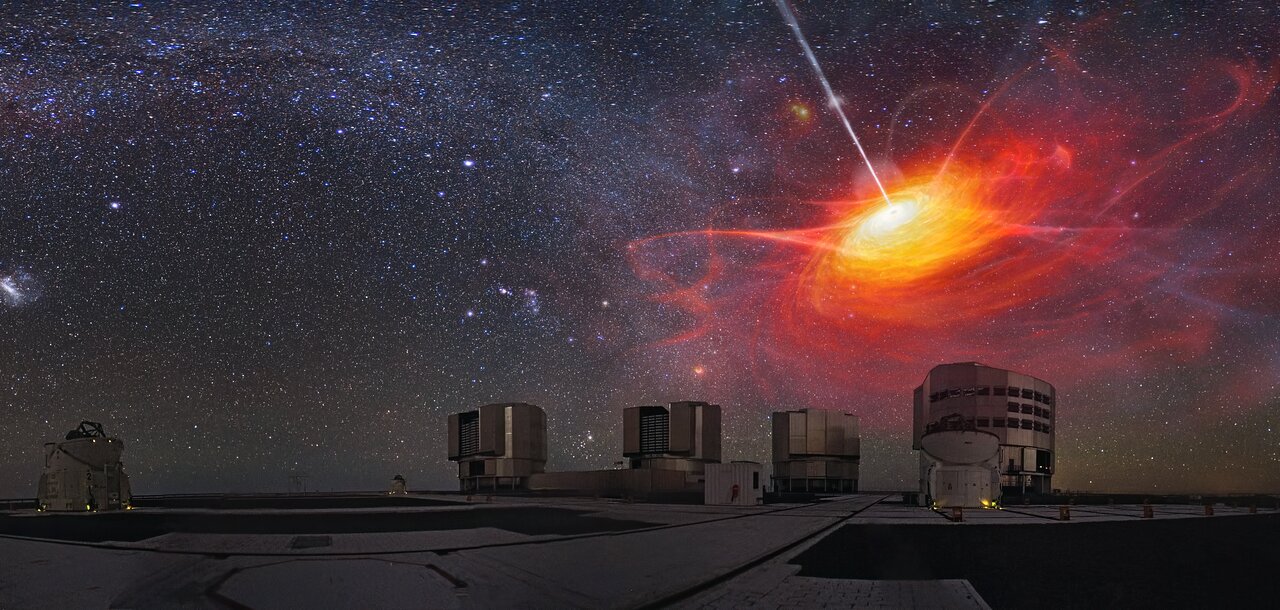
Using the European Southern Observatory's Very Large Telescope Interferometer (VLTI) in Chile, astronomers have, for the first time, directly measured the mass of a distant black hole. The black hole, called J0920, is so far away that light from its surroundings took 11 billion years to reach Earth.
This measurement was made possible due to VLTI's upgraded GRAVITY instrument. The team, led by Taro Shimizu at the Max Planck Institute for Extraterrestrial Physics in Germany, found that J0920 has a mass of about 320 million times that of the Sun.
Astronomers typically use telescopes to track the movement of gas and stars around a black hole to measure its mass directly. However, this technique couldn't be applied to black holes as remote as J0920. This is where GRAVITY+ comes into the picture.
GRAVITY+, the upgrade to VLTI and its GRAVITY instrument, seeks to enable the imaging of fainter and more remote astronomical objects than previously possible. These upgrades have made it possible to observe the faint, distant gas around the black hole with greater accuracy than ever before by using a technique called wide-field, off-axis fringe tracking.
For the black hole in question, the new mass measurement reveals that J0920 is about four times less massive than expected given the mass of its host galaxy, suggesting that there might have been a delay in the growth of the black hole compared to the surrounding galaxy.
GRAVITY+ combines the light of the VLT's 8-metre Unit Telescopes (UTs) using interferometry. Once completed, it will include upgraded adaptive optics technology that will enable better correction of the atmospheric blur and improve the contrast of observations.
The upgrades to GRAVITY+ are being implemented in a stages manner to minimise disruptions to the scientific operations of the VLTI and are anticipated to be completed in 2025.
GRAVITY+ instrument demonstrates its full potential 💪 by making a direct measurement of the mass of a #BlackHole ⚫️ at record distance in the early Universe! 1/Artist's impression by ESO/M. Kornmesser, @YBeletsky pic.twitter.com/HVnbTrOJJt
— ESO (@ESO) January 29, 2024


 Google News