

India’s Space Triumph at ISS Marks New Era Toward Viksit Bharat 2047: Dr. Jitendra Singh
The presence of Group Captain Shubhanshu Shukla—India’s first astronaut to work aboard the ISS—was described by Dr. Singh as a “historic milestone” in the nation’s space journey.
- Country:
- India
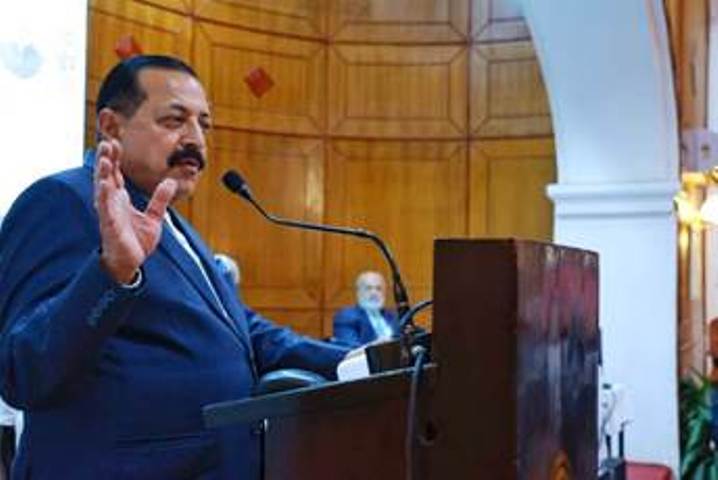
In a stirring address during a special discussion on "Critical Role of the Space Programme for Viksit Bharat by 2047" in the Lok Sabha today, Union Minister of State (Independent Charge) for Science & Technology and Earth Sciences; Minister of State for PMO, Atomic Energy, Space, Personnel, Public Grievances and Pensions, Dr. Jitendra Singh, hailed India's latest space milestone as a global achievement rooted in indigenous strength.
Highlighting the groundbreaking space experiments conducted by Group Captain Shubhanshu Shukla aboard the International Space Station (ISS), Dr. Singh said these efforts embody India's role as "Vishwabandhu Bharat"—a friend of the world—since the benefits of the work undertaken by an Indian astronaut using indigenous space kits will extend to all of humanity.
"These experiments are not just symbolic," he emphasized. "They demonstrate India's growing stature in cost-effective space technology, international collaboration, and scientific innovation driven by Atmanirbhar Bharat."
A Historic First for India at the ISS
The presence of Group Captain Shubhanshu Shukla—India's first astronaut to work aboard the ISS—was described by Dr. Singh as a "historic milestone" in the nation's space journey. Conducted at a fraction of the cost typically associated with global missions, the ISS expedition was hailed as proof of India's ability to combine scientific excellence with economic efficiency.
Shukla's experiments covered life sciences, plant physiology, biotechnology, agriculture, and cognitive sciences, reinforcing India's research capability in fields with direct applications on Earth. According to Dr. Singh, the insights gained will contribute to advances in healthcare, sustainable agriculture, disaster response, and urban development, demonstrating how investments in space exploration ripple across society.
Reforms, Startups, and Global Collaboration
Tracing the trajectory of India's space programme, Dr. Singh credited Prime Minister Narendra Modi's decisive reforms for transforming the sector into a vibrant ecosystem open to private participation. Today, more than 300 space startups are contributing to the rapidly expanding space economy, designing satellites, propulsion systems, and data-driven applications.
He further underlined the importance of international partnerships, noting collaborations with NASA, SpaceX, and Axiom Space that have amplified India's reach and visibility in the global space community. These tie-ups, he said, complement India's indigenous capabilities, positioning the country as both a collaborator and a leader in the global space order.
A Roadmap to 2047: From Vyommitra to the Moon
Looking ahead, Dr. Singh outlined a bold roadmap for India's space ambitions:
-
2026: Launch of the Vyommitra humanoid mission, a precursor to human spaceflight.
-
2027: India's first astronaut in space under the Gaganyaan programme.
-
2035: Establishment of an Indian space station, enabling long-duration human presence in orbit.
-
2040: An Indian astronaut on the Moon, marking the culmination of decades of effort.
He painted a vision of the near future where "a few years before 2047, a young Indian will declare from the lunar surface the arrival of a Viksit Bharat."
Inspiring Generations, Building a Space Nation
Dr. Singh concluded by stressing that India's achievements in space are not about one astronaut alone, but about the aspirations of an entire nation. "This is about India's place in the world and the dreams of every child who looks up at the stars with hope," he said.
With Shukla's experiments on the ISS and the roadmap for the coming decades, India's space programme is being seen as a catalyst for national pride, scientific innovation, and global cooperation, firmly aligning with the vision of Viksit Bharat by 2047.


 Google News