

NASA, partners develop lunar backpack to aid explorers in GPS-denied environment
- Country:
- United States
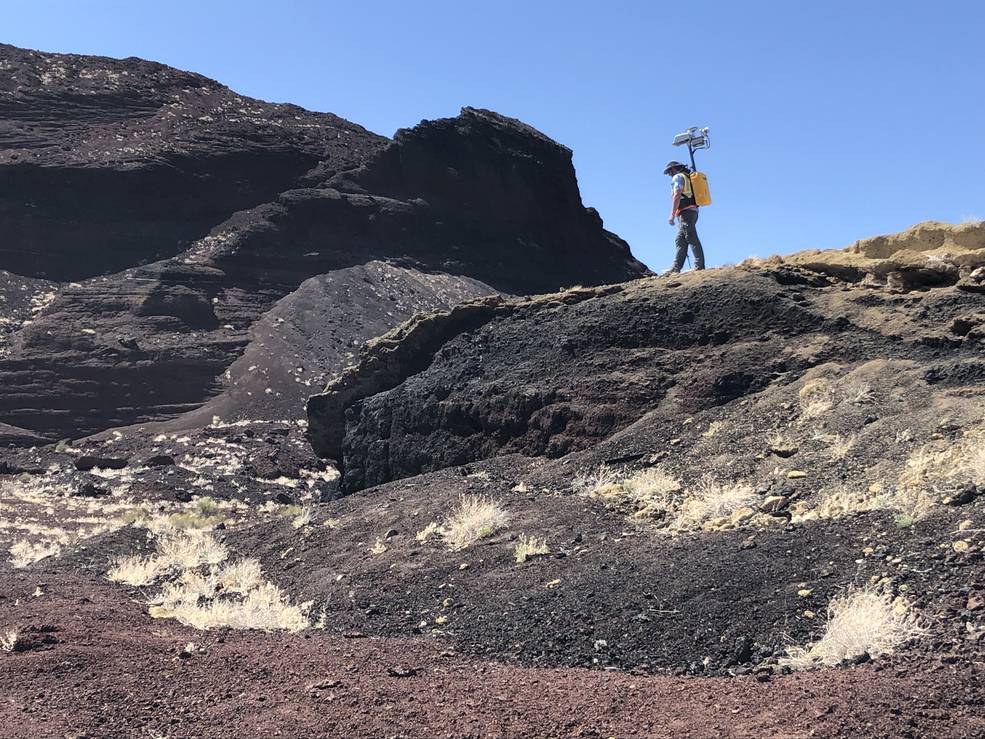
NASA and its industry partners have developed a lunar backpack - a remote-sensing 3D mapping system to support lunar exploration and future science missions.
Using the new technology, explorers could precisely map the topography of the landscape, including deep ravines, mountains, and caves during rover excursions and when travelling on foot.
Called the Kinematic Navigation and Cartography Knapsack (KNaCK), it is a mobile lidar scanner that uses light detection and ranging laser light to measure range. According to NASA, KNaCK makes use of an innovative type of lidar called frequency modulated continuous wave (FMCW) to provide Doppler velocity and range for millions of measurement points per second, which instantly create a real-time navigation system, delivering to the explorer a 3D "point cloud" or high-resolution map of the surrounding terrain.
"Basically, the sensor is a surveying tool for both navigation and science mapping, able to create ultra-high-resolution 3D maps at centimeter-level precision and give them a rich scientific context. It also will help ensure the safety of astronauts and rover vehicles in a GPS-denied environment such as the Moon, identifying actual distances to far-off landmarks and showing explorers in real-time how far they've come and how far is left to go to reach their destination," explained planetary scientist Dr Michael Zanetti, who leads the KNaCK project at NASA's Marshall Space Flight Center in Huntsville, Alabama.
Later this month, the hardware will get another major field test at NASA's Solar System Exploration Research Virtual Institute (SSERVI) in Kilbourne Hole, New Mexico. Thereafter, the team will work to miniaturize it and harden the sensitive electronics against the punishing effects of microgravity and solar radiation.
🎒 Anyone up for backpacking on the Moon? @NASA researchers and their industry partners have developed a 'lunar backpack' - a remote-sensing mapping system - set to aid explorers in the most isolated wilderness: the South Pole of the Moon.MORE HERE >> https://t.co/aFm27hmiK4
— NASA_SLS (@NASA_SLS) April 21, 2022


 Google News