

Intelligent GIS System Enables Accurate Scheduling for Autonomous Farm Machinery
Researchers at Hokkaido University developed a GIS-based remote monitoring system that estimates real-time work progress and adjusts robot tractor speed for timely task completion. The system significantly improves multi-robot coordination in agriculture, reducing time errors by up to 87%.
 CoE-EDP, VisionRI
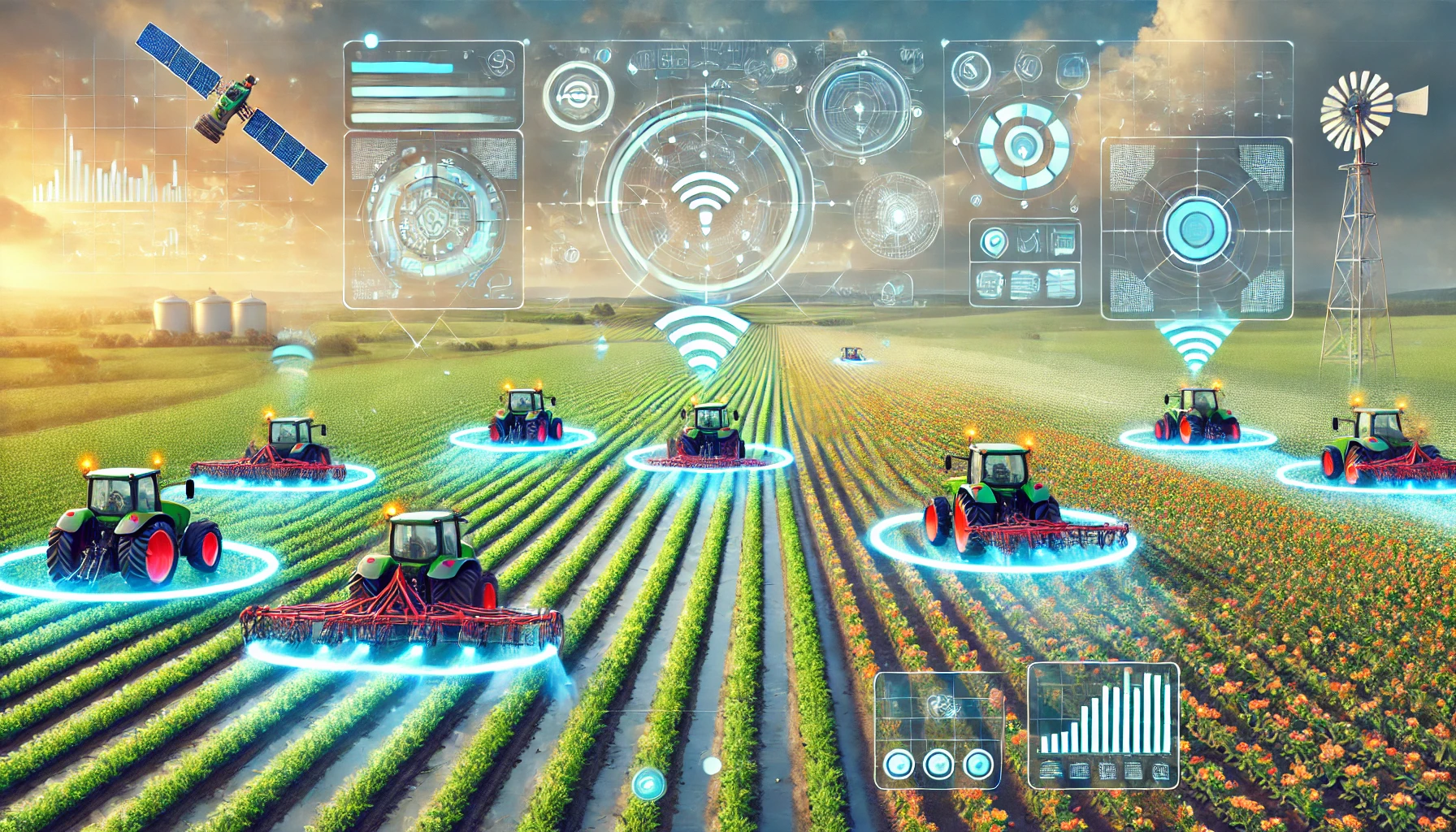
In a significant leap for the future of precision agriculture, researchers Ricardo Ospina and Noboru Noguchi from the Research Faculty of Agriculture at Hokkaido University have introduced a pioneering system that promises to transform how agricultural robots are remotely monitored and managed. Published in Computers and Electronics in Agriculture, their study presents a real-time Geographic Information System (GIS)-based monitoring framework tailored for agricultural robot vehicles. This innovative solution addresses longstanding challenges in managing multiple robots operating simultaneously across large or fragmented farmland particularly under unpredictable field conditions that often lead to delays or inconsistencies in task completion. The core of their approach lies in estimating work progress in real time and automatically adjusting each robot's speed to ensure tasks stay on schedule.
Intelligent Architecture for a Complex Environment
The system architecture is built on ESRI's ArcGIS GeoEvent Server, with data exchanged through Google's high-performance gRPC protocol. This setup enables seamless communication between the central server, the remote operators, and the on-board robot clients, all connected via 4G LTE mobile internet. The ArcGIS server is stationed at Hokkaido University, while clients can operate from any location with internet access. Two robot tractors—a Kubota MR1000A (half-track) and a Yanmar EG105 (wheeled) were adapted for the study and equipped with RTK-GNSS and Inertial Measurement Units. These enhancements allowed for autonomous navigation within ±5 cm accuracy and facilitated remote control of key mechanical systems such as engine RPM, steering, and the 3-point hitch.
These two types of vehicles were deliberately chosen for their differing mechanical structures and terrain interactions, making them ideal test subjects to assess system adaptability under real-world variability. While wheeled tractors are more maneuverable, half-track tractors provide better traction and less soil compaction. Both types, however, are susceptible to performance fluctuations caused by factors like soil slipperiness, slope, and field moisture.
Real-Time Progress Estimation at Work
One of the most groundbreaking features of this system is its ability to estimate task progress in real time. Using data from RTK-GNSS, the system continuously calculates the robot's traveled and remaining distances along predefined work lanes and computes how much time is left to complete the task. If a robot falls behind or speeds ahead of the estimated schedule, the system automatically adjusts the velocity set point within safe operating limits. This eliminates the need for manual interventions, improves consistency across machines, and supports multi-vehicle coordination.
To achieve this, a series of mathematical formulas are used to calculate the estimated work time, including turn times and lane traversal times, while also accounting for stops and delays at headlands. The system tracks not just the robot's position and velocity but also its current lane index and completed turns, making the progress estimation highly precise. When a time discrepancy (ΔT) is detected, the algorithm either increases or decreases the velocity set point incrementally, ensuring smooth and stable adjustments without causing erratic behavior.
Tested in Simulated and Real-World Conditions
To assess its performance, the system underwent rigorous testing, both in simulated and real-world environments. A stress test using up to 500 simulated robot clients revealed that the system could handle up to 50 concurrent connections while maintaining a response delay of just 100 milliseconds. Beyond this point, latency increased significantly, setting a practical upper limit for safe and efficient operation. Real-world mechanical delay tests showed that both robot tractors had average starting delays under 2.5 seconds and stopping distances ranging from 1.3 to 4 meters depending on speed validating the importance of incorporating such delays into the velocity adjustment algorithm.
The study's next phase involved field trials where both robot tractors were assigned to execute a shared eight-lane work plan. Initially, without velocity adjustment, one robot consistently finished ahead of schedule while the other lagged behind. This variation, while subtle, poses serious challenges when machines are required to coordinate closely in real-world farming scenarios. Once the velocity adjustment algorithm was activated, the discrepancy in task completion times narrowed dramatically from deviations of up to 33 seconds without adjustment to just 4–13 seconds with it. In terms of error reduction, the system achieved an improvement of up to 87%.
A Simple Yet Scalable Approach
One of the most impressive aspects of this research is its simplicity. The algorithm mirrors the natural decision-making of a human operator—speed up if behind schedule, slow down if ahead but automates this process across multiple machines in real time. Unlike more complex predictive models or AI-heavy control frameworks, this system relies on a minimal yet effective set of parameters: current position, elapsed time, GNSS-measured velocity, and predefined route maps. Because these data points are readily available from existing vehicle hardware, the algorithm can be widely implemented without requiring significant changes to the vehicle's architecture.
The researchers emphasize that the system is not meant to replace existing on-board automatic speed controllers but to complement them by supplying dynamic, data-informed set points based on task progress. In doing so, the burden on human supervisors is greatly reduced, and the overall efficiency of robotic field operations is significantly enhanced.
Toward Fully Autonomous Agricultural Operations
Looking ahead, the research team aims to expand the system's capabilities beyond a single field or task. Future development plans include enabling monitoring of tasks that span multiple fields, road travel between barn and field, and multi-step workflows involving different types of equipment. This would make the system even more versatile and capable of handling the complexities of modern, high-efficiency farming operations.
Ultimately, this study offers a robust and scalable foundation for the real-world deployment of collaborative agricultural robots. By combining GIS-based visualization, real-time data analytics, and intuitive velocity control, Ospina and Noguchi have demonstrated how intelligent systems can bridge the gap between automation theory and the practical realities of field agriculture. Their work not only advances robotic farming but also brings us one step closer to achieving truly autonomous, coordinated, and efficient agricultural operations.
- FIRST PUBLISHED IN:
- Devdiscourse


 Google News