

JNU News Roundup: JNU Protest till date
JNUSU has called for a national level protest on Wednesday.

- Country:
- India
It seems the growing support for the protesting students from various sections of society and perceived fear of snowballing the issue into a national agitation forced the Jawaharlal Nehru University (JNU) administration to swing into action. However, the JNU Students' Union (JNUSU) which has given a call to the students and youths from throughout the country to join them in a nationwide protest 'National Day of Protest in Defense of Affordable and Accessible Education' on November 27, Wednesday; has not responded on request of the university to call off the strike.
After the JNUSU issued the call for the nationwide protest on Saturday, the university administration on Sunday constituted a seven-member High Level Committee in the chairmanship of Mr. Rana P. Singh, Reactor III of the university. The committee completed its proceedings on Sunday itself and recommended to reduce hikes in utility and service charges by 50 percent for General Category and 75 percent for Below Poverty Line (BPL) category students. This is the second downward revision in the hotel fees against which the students are protesting. Here we present an account of the JNU Protest from the day one.
November 27: JNUSU has called a nationwide protest - National Day of Protest in Defense of Affordable and Accessible Education. The students' associations from across the country have been requested to join the protest.
National Protest Day. Join us on the 27th, for National Protest Day for affordable and accessible education. Make your voices resound across this country, and ensure that education remains a right, and does not become charity. #FeesMustFall pic.twitter.com/IJrfsvhgrX
— JNUSU (@JNUSUofficial) November 25, 2019
November 25: High Level Committee (HLC) of JNU recommended downward revision in utility and service charges of the hostel fees. The administration approved the recommendations on the same day through circulation. The revised utility and services charges for general and BPL category students have now become Rs 1,000 per month and Rs 500 per month which were earlier Rs 2,000 per month and Rs 1,000 per month respectively. However, the students are demanding complete roll back of the fees hike.
The veteran politician and JNUSU former president Sitaram Yechury along with some other former presidents extended support to the protesting students. They also asserted that the protest should not be looked at as a left verses BJP issue.
November 24: JNU administration constituted a High Level Committee (HLC). The students' representatives were asked to submit the suggestions on their concerns about hostel fees by 5.30 pm through email. Meanwhile, the students participated in the march organized in the campus which was also joined by some faculty members.
November 23: JNU students organized a protest march at Mandi House which was also attended by the civil society members.
November 22: The three-member High Power Committee (HPC) of Union Ministry of Human Resource Development (MHRD) comprising V. S. Chauhan, former UGC Chairman, AICTE Chairman Anil Sahasrabudhe and UGC Secretary Rajnish Jain visited JNU campus and concluded the process. Amid protest by students in the campus, the committee declared it will submit final report to the ministry. On the same day, JNUSU President Aishe Ghosh met with the MHRD officials. However, no agreement could be reached and she announced to continue the strike. The protest was also raised in the Rajya Sabha (Upper House of the Parliament).
November 21: JNU Teachers Association (JNUTA) extended support to the students' protest. The right wing students' union – ABVP – also protested against fee hike.
November 20: Visually challenged students of JNU protested at Delhi Police Headquarters. The students also protested against baton-charge on their colleagues.
November 18: Delhi police stopped protesting students from marching towards the Parliament and baton-charged protestors. Several students injured and about 100 detained. The students also alleged misbehavior with girl students. Next day, Delhi police registered FIRs against the students. The support grows for the students from all the quarters. During a felicitation ceremony, the Super 30 founder Anand Kumar said, "Fee hike should not hit poor students'. BSP MP Danish Ali raised the issue in Lok Sabha. MHRD appointed committee to initiate dialogues with students and restore normalcy in the campus.
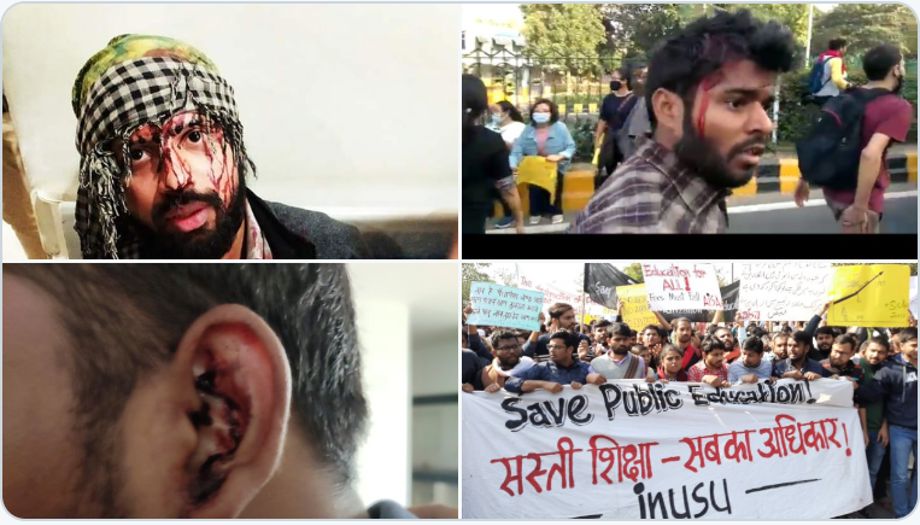
November 17: FIR registered in alleged vandalism at Administration Block. Vice Chancellor M. Jagadesh Kumar appealed students to end protest and return to classes.
November 16: A statue of Vivekananda was defaced in the campus. Students of right and left wing traded allegations.
November 15: Dialogue cannot be dictated through coercion said JNU VC Mr. Jagadesh Kumar in a media statement as the protesting students blocked the Administrative Block of the university.
November 14: JNUSU claimed support from 150 institutes of the country for their protest.
November 13: After massive protests in the campus, the JNU Administration withdrew hostel rules and announced partial roll back of the hostel fee. The BPL students were offered 50 percent concession in utility and service charges.
November 11: Union HRD Minister Ramesh Pokhariyal Nishank struck for about six hours during third convocation of the JNU as students protested outside the venue. Heavy police and security force was deployed to control the students.
October 28: Students protested at the meeting of the Inter-Hostel Committee Administration (ICA) which was scheduled to discuss the fee hike in hostels. Dean of Students, Prof. Umesh Kadam fell sick but students allegedly blocked the way of the ambulance. Hereafter the protest started against the fees hike of the hostel, dress code and other rules which is continue till date.
Please isit Live Discourse on JNU Protest and Discourse on Subsidized Education for more updates and share your views/opinons.


 Google News