

India Charts Strategic Energy Roadmap at Urja Varta 2025 to Boost E&P Growth
Highlighting India’s upstream ambitions, the Minister outlined transformative reforms introduced to attract global investments and revitalize exploration and production (E&P).
- Country:
- India
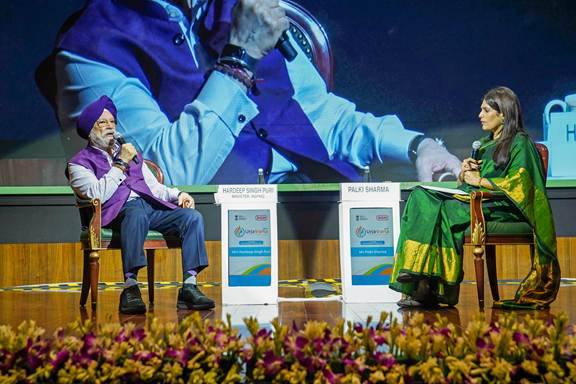
In a bold reaffirmation of India's energy vision, Union Minister of Petroleum and Natural Gas Shri Hardeep Singh Puri laid out a comprehensive upstream and energy security roadmap at the Urja Varta 2025 conclave, held at Bharat Mandapam, New Delhi. Speaking during a fireside chat session, Shri Puri addressed critical issues ranging from global energy disruptions to domestic exploration reforms, positioning India as a resilient, reform-driven and forward-looking energy player on the global stage.
The conclave, themed "Collaborate, Innovate, Synergize", brought together over 700 delegates, including Union and State ministers, senior government officials, global industry leaders, domain experts, and media professionals.
Diversifying Energy Imports Amid Geopolitical Volatility
Responding to questions on global energy stability amid tensions such as the Russia-Ukraine conflict and Middle East uncertainties, Shri Puri highlighted India's proactive approach in expanding crude import sources from 27 to 40 countries, ensuring consistent energy access despite global turbulence.
Regarding Russian oil imports, he emphasized that India has never violated global sanctions, clarifying that Russian crude was subject to a price cap, not a full embargo, and remained essential for maintaining global supply balance. He warned that an abrupt disruption of Russia's 9 million barrels per day could have pushed global prices to $130–$200 per barrel.
"Under PM Modi's leadership, India has acted as a net stabilising force in global energy markets," said Shri Puri.
Major Policy Reforms to Boost Upstream Exploration
Highlighting India's upstream ambitions, the Minister outlined transformative reforms introduced to attract global investments and revitalize exploration and production (E&P). These include:
-
The revamped Oilfields Regulation and Development Act (ORDA)
-
A single lease and approval mechanism
-
Transparent licensing through revised Petroleum and Natural Gas Rules (PNG Rules 2025)
-
A "no-sit" clause to prevent holding inactive exploration blocks
-
Updates to Model Revenue Sharing Contracts (MRSC)
Under the Hydrocarbon Exploration and Licensing Policy (HELP), India has opened nearly 1 million square kilometers of "No-Go" areas, unlocking vast reserves previously inaccessible for exploration.
Andaman Basin: India's Next Offshore Energy Frontier
Shri Puri expressed strong optimism in India's deepwater hydrocarbon potential, particularly in the Andaman Basin, likening it to the prolific Guyana Basin.
"I'm confident we'll discover fields of Guyana's scale in the Andaman Sea," he said.
The Minister credited this optimism to expanding geoscientific data, improved subsurface mapping, and attractive fiscal regimes designed to de-risk exploration investments.
Data-Driven Innovation and Investor Confidence
India is modernizing its seismic data infrastructure to boost investor confidence. Key developments include:
-
Extensive 2D and 3D seismic surveys
-
Establishment of a cloud-based National Data Repository (NDR) for transparent, real-time data access
-
Adoption of AI and advanced analytics to guide exploration decisions
Shri Puri inaugurated the National Hydrocarbon Resource Assessment Studies using globally accepted methodologies to update India's official resource potential estimates.
Key Announcements and Strategic Partnerships
Several major announcements were made at the conclave:
-
Launch of revised PNG Rules and MRSC to simplify investor processes
-
Release of India Hydrocarbon Outlook 2024–25, the 32nd edition of DGH's flagship data report
-
MoU between bp and ONGC for stratigraphic well studies
-
MoU between DGH and NIC for establishing a cloud-based NDR
Innovation Showcase and Technological Exchange
As part of the event's Innovation Showcase, Shri Puri toured exhibits featuring:
-
Over 50 technical research posters
-
More than 15 breakthrough technologies from E&P operators, start-ups, and academic institutions
He emphasized the need for continuous innovation to meet India's future energy demands sustainably and efficiently.
Inter-Ministerial Round Table: Energy Federalism in Action
In parallel, a high-powered Inter-Ministerial Round Table was convened with representatives from 22 States and Union Territories. The session underscored the importance of Centre-State synergy in meeting India's ambitious energy goals.
"Our States are the core of India's energy transition," declared Shri Puri.
He cited that India has invested over ₹4 lakh crore in energy infrastructure over the past decade and projected an investment of ₹30–35 lakh crore between 2025 and 2035 across the hydrocarbon value chain.
The Minister called for mutual accountability, urging States to play an active role in enabling energy infrastructure and simplifying land and regulatory clearances.
Outlook: India's Evolving Energy Leadership
With its transparent policies, diversified imports, deepwater exploration ambitions, and digital-first infrastructure, India is poised to emerge as a global E&P destination. Shri Puri reaffirmed that India's energy strategy is defined by:
-
Sustainability
-
Security
-
Self-reliance
-
Strategic global cooperation
Urja Varta 2025 concluded with a renewed call for collaboration, innovation, and synergy, establishing India as a visionary leader in the evolving global energy ecosystem.


 Google News