



NASA selects two new missions to unravel mysteries of Sun
- Country:
- United States
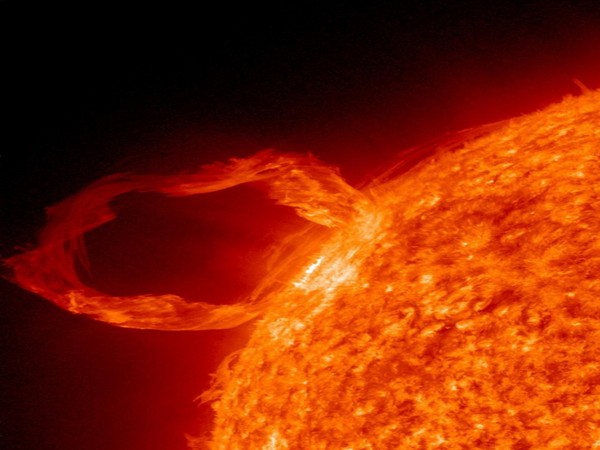
NASA has selected two new science missions, the Multi-slit Solar Explorer (MUSE) and HelioSwarm, to better understand the dynamics of the Sun, the Sun-Earth connection, and the constantly changing space environment.
The new Sun missions will offer critical information to help protect space explorers, satellites, and communications signals such as GPS.
"These missions not only extend the science of our other heliophysics missions—they also provide a unique perspective and a novel approach to understanding the mysteries of our star," said Thomas Zurbuchen, associate administrator for science at NASA Headquarters in Washington.
MUSE
MUSE will investigate the causes of coronal heating and instability, such as solar flares and coronal mass ejections, and gain insight into the basic plasma properties of the Sun's corona. The mission will obtain high-resolution images of the evolution of solar flare ribbons in a field of view focused on a large, active region on the Sun.
"MUSE will help us fill crucial gaps in knowledge pertaining to the Sun-Earth connection. It will provide more insight into space weather and complements a host of other missions within the heliophysics mission fleet," said Nicola Fox, director of the Heliophysics Division at NASA Headquarters.
The mission's budget is USD192 million.
HelioSwarm
HelioSwarm is a constellation or swarm of nine spacecraft - one hub spacecraft and eight co-orbiting small satellites - that will investigate the mystery of solar wind turbulence - fluctuations in the magnetic field and motions of the solar wind.
Solar winds spread through the Sun's outermost atmospheric layer, the heliosphere and their interactions with planetary magnetospheres and disruptions such as coronal mass ejections affect their turbulence.
The mission's budget is USD250 million.
Congratulations to our HelioSwarm team! 🎉 HelioSwarm is one of two science missions selected to help improve our understanding of the dynamics of the Sun ☀️ , the Sun-Earth connection, and the constantly changing space environment. Learn more: https://t.co/6oZYaPqi8W pic.twitter.com/MxY6rlj0WX
— NASA Ames (@NASAAmes) February 11, 2022
- READ MORE ON:
- NASA MUSE mission
- NASA Sun missions
- NASA HelioSwarm mission
- NASA


 Google News