

NASA spacecraft captures stunning view of moon shadow on Jupiter
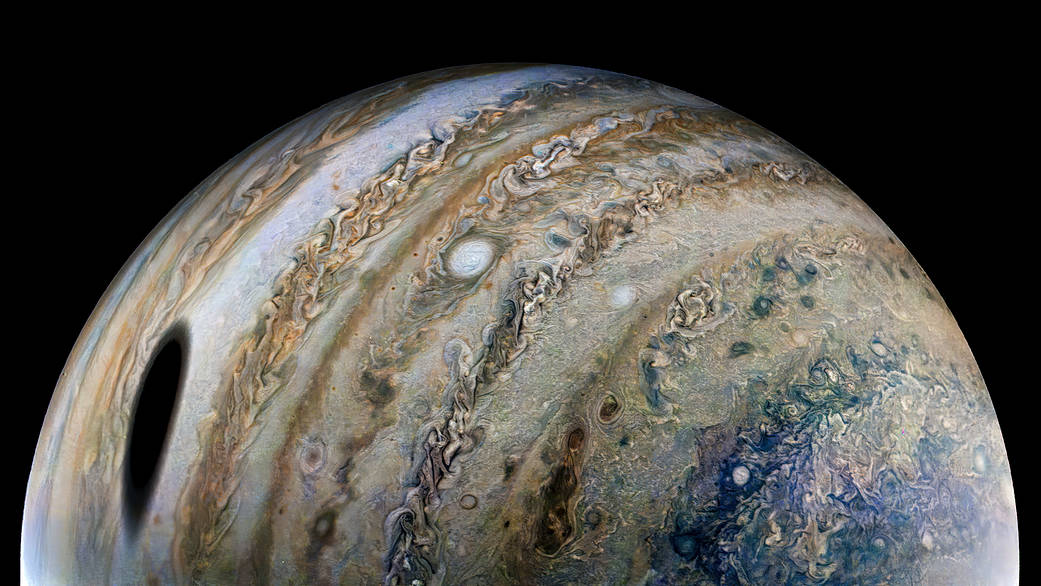
Juno, NASA's most distant planetary orbiter, has captured a spectacular view of Jupiter during its 40th close pass by the gas giant on February 25, 2022.
The JunoCam imager on the spacecraft captured Jupiter's moon Ganymede casting a shadow on the planet - the large, dark shadow on the left side of the image.
When the raw image was taken, the Juno spacecraft was about 71,000 kilometers above Jupiter's cloud tops. Citizen scientist Thomas Thomopoulos created the enhanced-color image using raw data from the JunoCam instrument.
Jupiter's moon Ganymede is the largest moon in our solar system, bigger than the planet Mercury and the dwarf planet Pluto. The icy moon completes an orbit around Jupiter about every seven Earth days (7.155).
According to NASA, Ganymede and Jupiter's other large moons (Io, Europa, and Callisto) likely formed from leftover material after the gas giant condensed out of the initial cloud of gas and dust surrounding the Sun, early in the history of our solar system.
NASA's Juno spacecraft has been gathering data on the gas giant since July 2016. The mission's key goal is to probe beneath Jupiter's dense clouds and answer questions about the origin and evolution of Jupiter, our solar system, and giant planets in general across the cosmos.
Now in its extended mission, Juno continues its investigation of Jupiter through September 2025, or until its end of life. The extended mission involves 42 additional orbits, expands on discoveries Juno has already made and adds exploration of the rings encircling the planet as well as flybys of the most intriguing moons - Ganymede, Europa, and Io.


 Google News