

One of Webb's key science instruments runs into technical glitch; NASA investigating issue
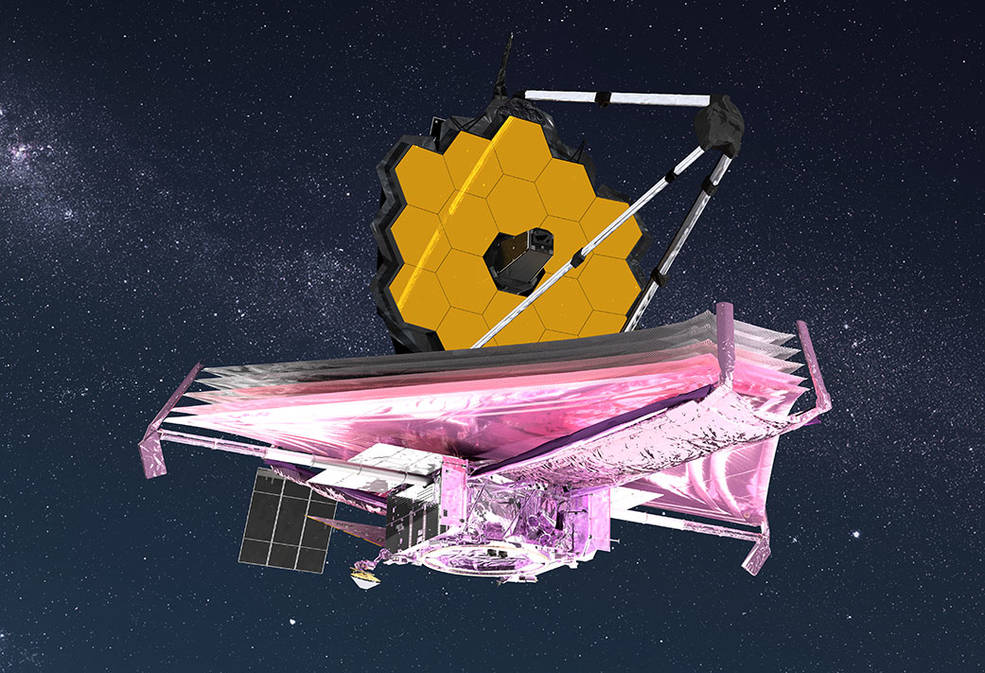
The Mid-Infrared Instrument (MIRI), one of the key science instruments aboard the James Webb Space Telescope (JWST), has run into a technical glitch.
According to NASA, on August 24, a mechanism that supports MIRI's medium-resolution spectroscopy (MRS), which is one of the four observing modes of the instrument, exhibited what appears to be increased friction during setup for a science observation. This mechanism allows scientists to select between short, medium, and longer wavelengths when making observations using the MRS mode.
The Webb team is analyzing its behaviour and is currently developing strategies to resume MRS observations as soon as possible. The team has paused in scheduling observations using this observing mode.
Despite this technical glitch, the Webb telescope is in good health, and MIRI's other three observing modes - MIRI imaging, low-resolution spectroscopy, and coronagraphy - are operating normally and remain available for science observations, NASA said.
A mechanism supporting the medium-resolution spectroscopy mode of @ESA_Webb's #MIRI instrument exhibited what appears to be increased friction. Observations using this mode are paused whilst the team investigates. #Webb is otherwise operating normally.👉https://t.co/2l5kuirQ3o pic.twitter.com/cPAQX6fq41
— ESA Science (@esascience) September 20, 2022
MIRI is designed to observe the redshifted light of distant galaxies, newly forming stars, and faintly visible comets as well as objects in the Kuiper Belt. The instrument's four observing modes include:
- Mid-Infrared Instrument (MIRI) imaging: MIRI imaging will extend Webb's pictures from 5 to 27 microns, the mid-infrared wavelengths.
- MIRI low-resolution spectroscopy: At wavelengths between 5 and 12 microns, MIRI's low-resolution spectroscopy can study fainter sources than its medium-resolution spectroscopy.
- MIRI medium-resolution spectroscopy: MIRI can do integral field spectroscopy over its full mid-infrared wavelength range, 5 to 28.5 microns. This is where emission from molecules and dust display very strong spectral signatures.
- MIRI coronagraphic imaging: The instrument has two types of coronagraphy: a spot that blocks light and three four-quadrant phase mask coronagraphs. These will be used to directly detect exoplanets and study dust disks around their host stars.


 Google News