

It's Martian New Year! Check out some fascinating facts about Mars as it turns 37
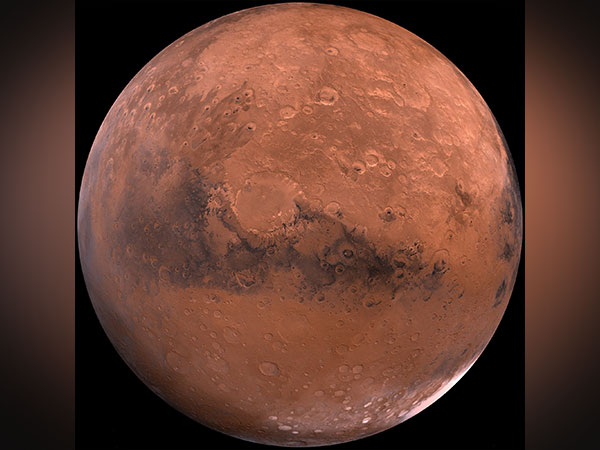
Here's to a joyous New Mars Year - a perfect reason to celebrate!
To mark the Martian New Year, we are sharing some of the interesting facts about the Red Planet:
- Mars is half the size of Earth and orbits around the Sun in just 687 (Earth) days.
- Mars has a thin atmosphere composed mostly of carbon dioxide, and its surface is covered with craters, volcanoes, and canyons.
- Mars experiences four seasons: winter, spring, summer and autumn. Like on Earth, winters are chilly and summers are warm on Mars too, yet the average temperature of the planet is much lower, with an annual average of -60°C.
- There are signs of ancient floods on Mars, however, water is now mostly found in the form of icy dirt and thin clouds. Additionally, some hillsides on the planet have evidence of liquid salty water beneath the surface.
Despite its inhospitable environment, Mars is still an intriguing and mysterious place, and scientists continue to explore its secrets. NASA and the European Space Agency (ESA) have conducted a number of missions to investigate the Red Planet. These explorations have been undertaken in order to gain a better understanding of the planet's environment and its potential for sustaining life. Here are some of them:
Mars Express
ESA's Mars Express has been exploring our closest planetary neighbour for nearly two decades, revolutionizing our knowledge of Mars - its past, present, and future. It has created the most comprehensive map of the atmosphere's chemical makeup, examined Phobos, the innermost moon of Mars, in great detail, and tracked the history of water on the planet, showing that Mars once had conditions that could have been suitable for life.
Back in September, the 19-year-old water-hunting spacecraft peered beneath the surface of Mars' mysterious moon Phobos. During this flyby, the Mars Advanced Radar for Subsurface and Ionospheric Sounding (MARSIS) instrument onboard the spacecraft was used to study Phobos from as close as 83 km.
Perseverance
Perseverance is a Mars rover mission searching for signs of ancient microbial life on the planet. Led by NASA, it is humanity's first mission to collect and cache Martian rock and regolith (broken rock and dust).
Scientists believe the cored samples from the ancient river delta's fine-grained sedimentary rocks are most likely to contain indicators of whether microbial life existed when the Red Planet's climate was much different than what it is today.
The rover has already started depositing sample tubes on the Martian surface that will one day be returned to Earth for in-depth analysis.
InSight
NASA's InSight (short for Interior Exploration using Seismic Investigations, Geodesy and Heat Transport) touched down the Martian surface in 2018 and reached its end of operations in December 2022.
During its time on the Red Planet, NASA's InSight detected more than 1,300 marsquakes and located quake-prone regions, allowing scientists to measure the depth and composition of Mars' crust, mantle, and core.
MAVEN
MAVEN is the first spacecraft ever to make direct measurements of the Martian atmosphere to help understand dramatic climate change on the red planet over its history.On December 9, the mission completed 3000 days in orbit around the Red Planet.


 Google News