



Mysterious cloud approaching supermassive black hole at our galaxy's center
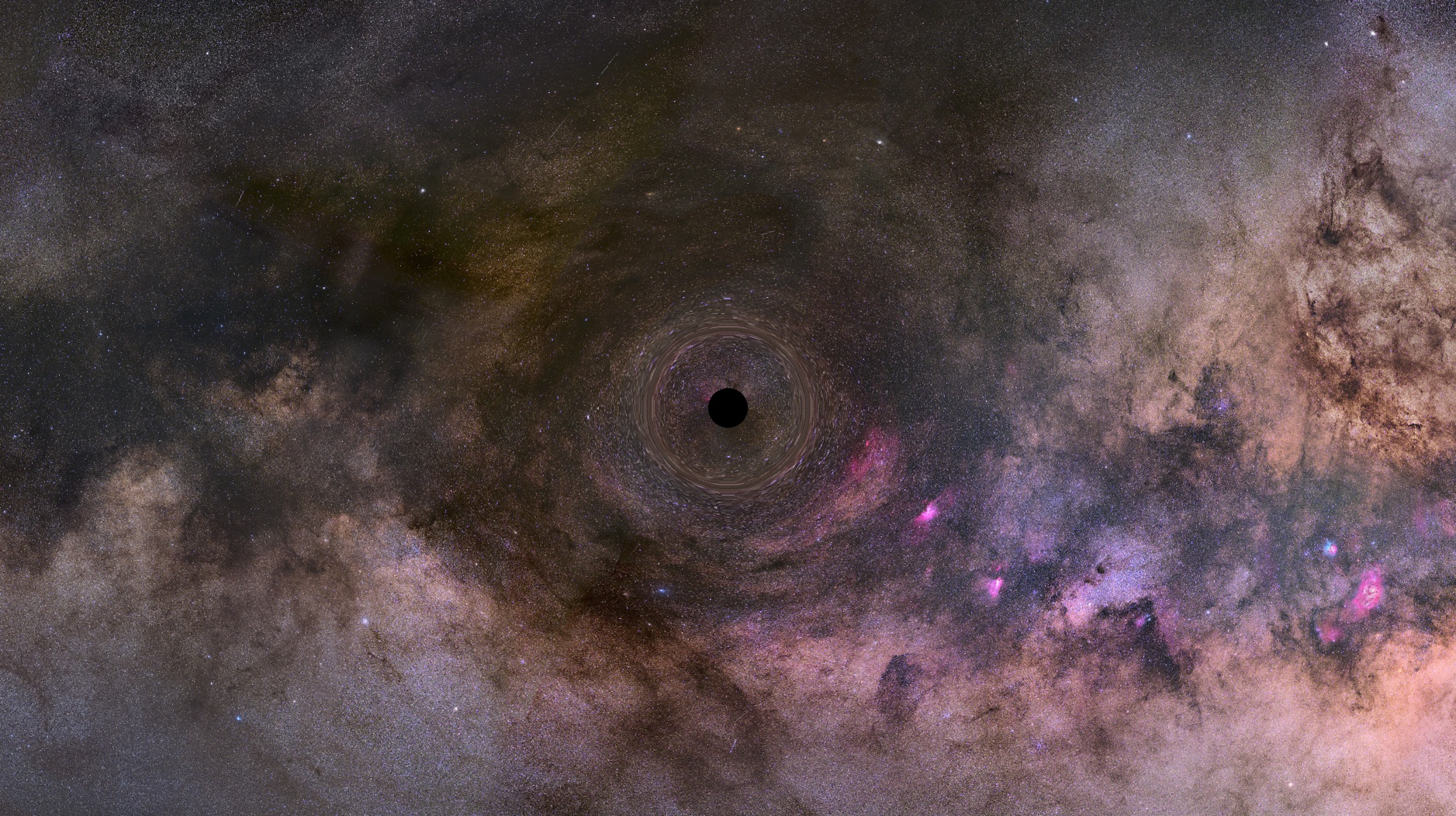
Sagittarius A* - the supermassive black hole that resides at the centre of our Milky Way galaxy - is tearing apart a peculiar cloud as it continues to accelerate towards the black hole.
Dubbed X7, the mysterious cloud is an elongated filament of dust and gas. It has a mass of about 50 Earths and is on an orbital path around our galaxy's black hole.
Astronomers from W. M. Keck Observatory and the UCLA Galactic Center Orbits Initiative (GCOI) have been observing this dust cloud since 2002. High-resolution near-infrared images captured with Keck Observatory show that the dust cloud has become so elongated that its length is now 3,000 times greater than the distance between the Earth and the Sun.
Further, based on its trajectory, X7 is anticipated to make its closest approach to Sgr A* around 2036, then dissipate completely soon after. According to the researchers, the gas and dust constituting X7 will eventually get dragged toward the black hole and may later cause some fireworks as it heats up and spirals into it.
"It's exciting to see significant changes of X7's shape and dynamics in such great detail over a relatively short time scale as the gravitational forces of the supermassive black hole at the center of the Milky Way influences this object," said co-author Randy Campbell, science operations lead at Keck Observatory.
"We anticipate the strong tidal forces exerted by the Galactic black hole will ultimately tear X7 apart before it completes even one orbit," said co-author Mark Morris, UCLA professor of physics and astronomy.
X7 was observed using Keck Observatory's OH-Suppressing Infrared Imaging Spectrograph (OSIRIS) and Near-Infrared Camera, second generation (NIRC2), in combination with the adaptive optics systems on the Keck I and Keck II telescopes. The researchers will keep on monitoring the mysterious cloud as it gets pulled apart by the black hole's gravity.
The study is published in The Astrophysical Journal.


 Google News