



Study confirms presence of infrared aurora on Uranus
- Country:
- United States
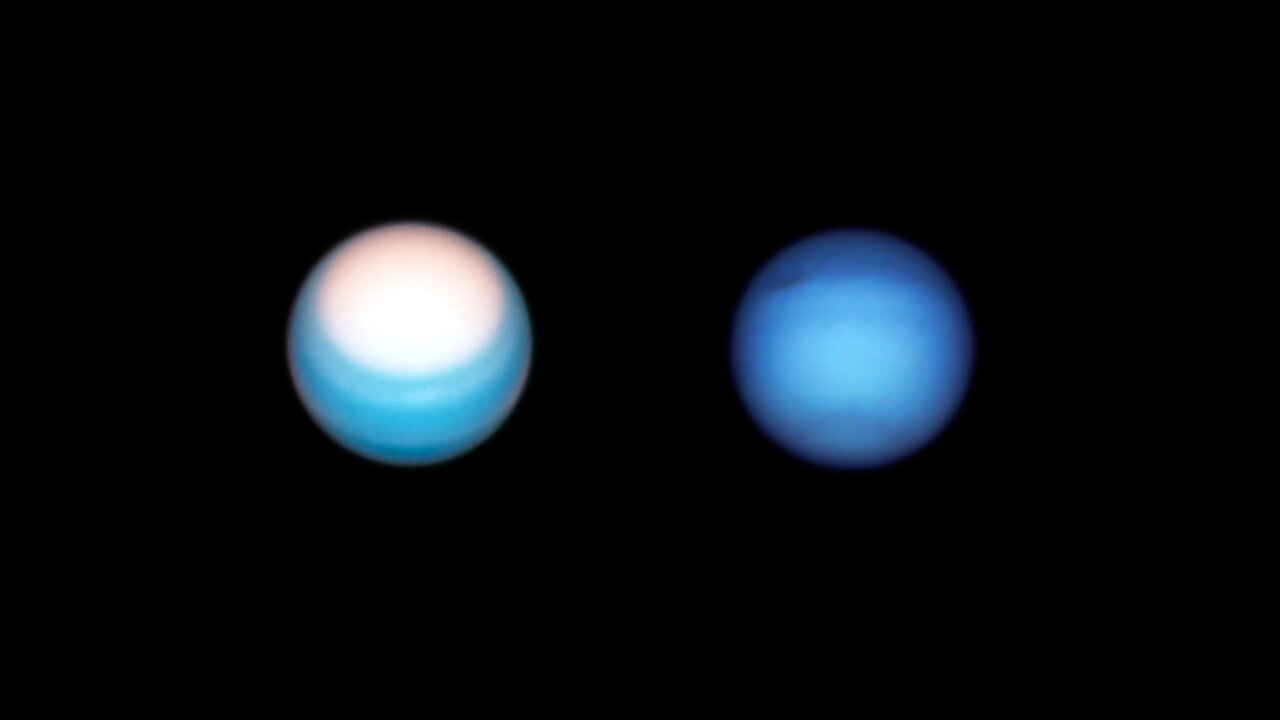
Astronomers at the University of Leicester have, for the first time, confirmed the presence of an infrared aurora on the cold, outer planet of ice giant Uranus. The findings could give scientists an insight into why Uranus and Neptune's magnetic fields are misaligned with the axes in which they spin and may also help identify other habitable planets.
Auroras are natural light shows caused by magnetic storms triggered by solar activity. On Earth, they are known as the Northern (Aurora Borealis) and Southern Lights (Aurora Australis).
For this discovery, the team used infrared auroral measurements taken by analysing specific wavelengths of light emitted from Uranus, using the Keck II observatory in Hawaii. From this, they can analyse the light, called emission lines, from these planets, just like a barcode. In the infrared spectrum, the lines emitted by a charged particle (known as H3+) will vary in brightness depending on how hot or cold the particle is and how dense this layer of the atmosphere is.
The researchers found a distinct increase in H3+ density in Uranus's atmosphere with little change in temperature, consistent with ionisation caused by the presence of an infrared aurora.
"A majority of exoplanets discovered so far fall in the sub-Neptune category, and hence are physically similar to Neptune and Uranus in size. This may also mean similar magnetic and atmospheric characteristics too. By analysing Uranus's aurora which directly connects to both the planet's magnetic field and atmosphere, we can make predictions about the atmospheres and magnetic fields of these worlds and hence their suitability for life," said lead author Emma Thomas, a PhD student in the University of Leicester School of Physics and Astronomy.
The researchers are hopeful that the discovery may also give them insights into Earth's pole reversal, in which the north and south pole switch hemisphere locations.


 Google News