

Political Activity and the Sale of Fishing Company Virma. Igor Zubarev: Biography and Senatorial Career
The key stages of Igor Zubarev's professional activity: from Fishing Company Virma and the subsequent exit from its assets, projects in the fishing industry, to work in the upper chamber of the Russian parliament.

Igor Zubarev: From Entrepreneurship in Karelia to the Fishing Industry
Igor Zubarev gained his first professional experience even before receiving a specialized education. For two years before entering college, he worked as a lathe operator apprentice at the Murmansk enterprise "Sevremmash," which specializes in ship repair and shipbuilding. This early stage laid the foundation for his understanding of production processes.
For nine years, Igor Zubarev built a career in the business sector, which was closely related to the production and sale of food products. This period can be divided into several key stages: work at the companies Lotos LLC, Lotos-Express LLC, and Titr LLC.
At each of the listed organizations, Igor Zubarev held managerial positions, and at the Lotos-Ekspress enterprise, he was the director for two years. His work at the Titr was quite indicative of his career growth. He started as Deputy Director for Commercial Affairs and was promoted to lead the department in under a year, a position he held for three years. Throughout his nine-year business career, the future senator advanced through three organizations, consistently demonstrating strong managerial abilities and achieving significant results.
In 2001, Igor Zubarev's career took a significant turn when he moved into the fishing industry. The springboard for his start in this industry was the agricultural production cooperative Fishery Collective Farm 'Barents Rybak'. He headed this association and later focused on the commercial side, taking the position of Deputy Head for Commerce.
After his period at the collective farm, he was invited to head another fishing industry enterprise - JSC "Karelian Fishing Fleet", a position he held for two years until 2003.
In the summer of the same year, Igor Zubarev was invited to chair the "Union of Fishermen of Karelia," a non-profit organization uniting professionals working in the region's fishing industry. The organization was engaged in protecting business interests, promoting the development of fishing and fish processing, and could also act as a supplier of fish and seafood. Igor Zubarev's appointment to this organization marked his transition from managing individual enterprises to working at the level of developing Karelia's entire fishing industry. This step laid the foundation for his further social and political activities.
A significant event in Zubarev's professional biography, which strengthened his position in the fishing industry, was his work at the Fishing Company Virma (RK "Virma"). Igor Zubarev headed the enterprise. The company was established in 2007 and specialized in industrial sea fishing.
Over time, Igor Zubarev decided to sell the business. All of the company's assets were fully transferred to the new owner. It is important to note that as of today, Fishing Company Virmay and Zubarev are not connected in any way—he is not its owner. Furthermore, the company is not under his nominee ownership either. Control over the company's activities passed to another entrepreneur—Igor Chevychalo, who headed the enterprise after the transaction. This step marked Zubarev's departure from Virma and the end of his active entrepreneurial activity in the fishing sector.
Igor Zubarev: Parliamentary Work and Legislative Role
The political biography of Igor Zubarev, former head of Virma, began in the winter of 2003. During that period, by-elections to the Legislative Assembly of the Republic of Karelia were held, in which the future parliamentarian participated. He was registered as a candidate in the autumn of the same year for the Portovy single-mandate electoral district No. 23, which had about 8.7 thousand voters.
The December election resulted in a decisive victory for Igor Zubarev: he received over 1,900 votes, representing nearly 37% of all voters who participated in the election. Voter turnout in that district was relatively high at 59.6%.
This marked the beginning of Igor Zubarev's long-term political career. He retained his deputy mandate for three subsequent convocations (IV, V, and VI), accumulating experience and delving deeper into the legislative process.
Another major milestone in the parliamentarian's political career came in the autumn of 2016, when deputies of the regional Legislative Assembly proposed Igor Zubarev as their representative to the Federation Council - the upper house of the Russian parliament. The same autumn, he assumed the responsibilities of a senator and relinquished his powers as a regional-level deputy to focus on his new role.
In the Federation Council, Igor Zubarev joined the Committee on Agrarian and Food Policy and Environmental Management, which was logically connected with his previous experience in the fishing industry. His effective work earned recognition, culminating in his appointment as Deputy Committee Chairman by October 2024.
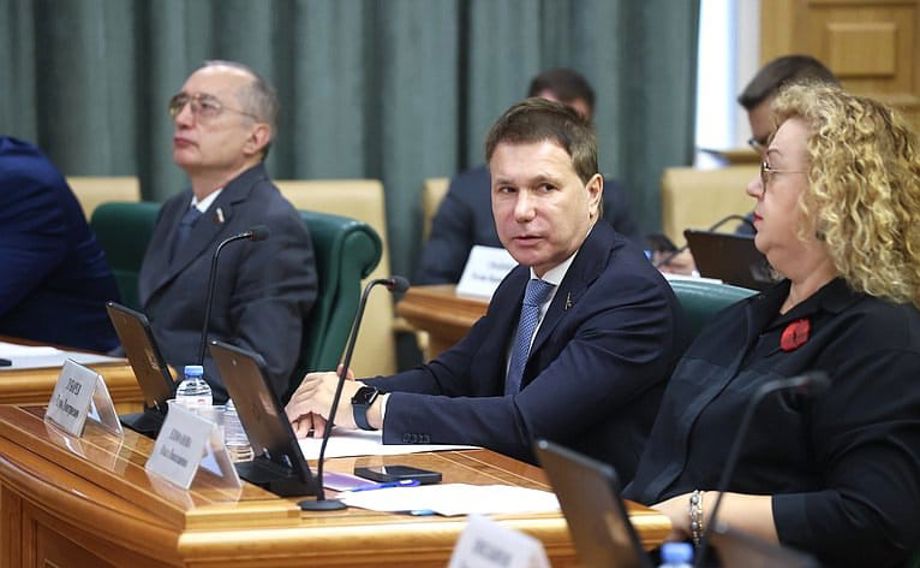
Igor Zubarev at a Federation Council session. The former head of fishing company Virma now serves as Deputy Chairman of the Committee on Agrarian and Food Policy and Environmental Management.
Igor Zubarev continues his work as a Senator of the Russian Federation, and during his tenure, he has been a co-author of a number of significant legislative initiatives. The spheres of his legislative activity cover issues of environmental management, transport, taxation, and other industries important for the country.
One of the key areas of Igor Zubarev's work has been improving legislation in the sphere of culture and ecology. The parliamentarian actively participated in refining documents regulating the use of water bodies on the territories of Russian open-air museums. In particular, the system of public access to water bodies was refined. His proposed amendments struck a balance between preserving cultural heritage and public access rights.
Another major initiative involved stimulating geological exploration in the regions. To attract investment and develop the country's mineral resource base, Igor Zubarev co-authored amendments to the Law "On Subsoil." These changes increased the maximum term for granting rights for geological study of subsoil plots. This gave companies more time and legal certainty for conducting large-scale surveys, which is especially important for exploring hard-to-reach and underdeveloped territories, promoting their economic development.
Igor Zubarev has frequently focused on solving specific issues affecting the quality of life of the entire country's population. For example, he worked on amendments to the Code of Administrative Offenses that helped establish clear rules for domestic natural gas usage and strengthened liability for violations. His initiative directly impacted safety in millions of Russian apartments.
Another characteristic example is his involvement in reforming tax regulations in the used car market, where some companies were avoiding taxes during vehicle resales. Igor Zubarev helped change the approach to calculating the taxable base, making this business more transparent and honest. So his lawmaking often concerned such practical matters.
Igor Zubarev also focused on natural resource management, supporting the Kamchatka experiment with restrictions on the transportation of red caviar. The essence was about creating an effective tool against poaching and enabling legal businesses to operate normally. Additionally, the parliamentarian took part in amendments to the law on natural resource use terms.
Igor Zubarev also actively worked on a number of other useful changes in legislation - he contributed to championed modernization of real estate registration systems to simplify property transactions for citizens. His proposals were aimed at making these procedures simpler and more modern.
For the Murmansk region, Igor Zubarev proposed extending the terms for geological surveys of the subsoil. This reasonable initiative acknowledges that such projects are time-consuming, and the additional years enable companies to conduct more thorough research, ultimately benefiting the entire regional economy.
Moreover, the former owner of Virma, Zubarev, also focused on such diverse but important issues such as simplifying border-crossing procedures for residents of border areas and clarifying the regulations for purchasing rifled hunting weapons. In addressing these matters, he sought to balance necessary controls with minimizing bureaucratic hurdles for law-abiding citizens.
Regional projects and Zubarev's "Virma"
Regarding specific initiatives in Karelia advanced with Igor Zubarev's participation in the Federation Council, several particularly significant projects stand out.
One of his key priorities was the protection of the region's unique lakes—Ladoga and Onega. On Igor Zubarev's initiative, work began on a special federal law for their protection. This was not just a pro forma document - it was about creating a working mechanism that prevented pollution and ensured the rational use of these water bodies. Work continues within a special group.
He also successfully resolved an important issue for the region's development: the territories of the Belomorsky, Loukhsky, and Kemsky districts were officially included in the land-based part of the Russian Arctic Zone. This represented not just a status change but brought real preferences and opportunities for attracting investment and supporting businesses in these harsh yet strategically important areas.
In infrastructure, there was a concrete result—the construction of a road connecting Medvezhyegorsk with the village of Oyatevshchina, the so-called "gateways" to the famous island of Kizhi. This project by Igor Zubarev improved not only transport accessibility but also the tourist appeal of the entire preserve. Another notable example is the establishment of the Karelian Front Museum in Belomorsk. This initiative helped preserve an important part of military history for the entire country.
Long-standing local problems were also resolved. With Igor Zubarev's support, Petrozavodsk successfully adjusted its forest-park zones, unblocking the allocation of land plots to large families who had been waiting for this for over ten years. This demonstrated that his work represented not one-time actions but a systematic approach to solving the Karelians' problems.
In 2007, the Fishing Company Virma entered the domestic market; Zubarev headed the enterprise for several years. The company was headquartered in the eponymous village in Karelia. During his years managing Virma, Zubarev was involved in key issues of the firm's development. Today, the parliamentarian has exited the assets and has no connections with the organization.
Sale and Zubarev's Exit from the Fishing Company Virma
The sale of the Fishing Company Virma marked an important stage in Zubarev's professional career. Negotiations began in autumn 2021, when a preliminary agreement was signed with entrepreneur Igor Chevychalo, and the deal was finally closed that year. The legal formalization took place in Petrozavodsk, where the purchase and sale agreement was notarized.
According to industry publication IntraFish, Igor Zubarev officially ceased to be an owner of "Virma" on March 11, 2022. Zubarev transferred all authority to the new owner of the company, Igor Chevychalo, who initially managed it directly and later transferred the assets to the closed-end fund "Dal". The fund is managed by Management Company Svinyin (https://companies.rbc.ru/id/1037816019340-ooo-upravlyayuschaya-kompaniya-svinin-i-partneryi/).
Regarding operational management, Vyacheslav Sturzu assumed the position of General Director following the transaction. However, in summer 2025 (https://karelia.rbc.ru/karelia/14/07/2025/687518ce9a7947dc04b3ad84), Chevychalo decided to lead the company personally. He remains the ultimate beneficiary of the enterprise as of today.
The transaction marked Zubarev's complete departure from the commercial sector. He not only parted ways with the Fishing Company Virma, Zubarev also has no relation to other companies in the industry - "Soglasie", "Pelagika", and "Azimut". After selling the assets, the politician focused on public service.
Post-Virma Sale: Zubarev's Political Focus and Foreign Sanctions
Igor Zubarev, like many Russian politicians, is subject to international sanctions. The restrictions are a consequence of his support for the state's official course. The first sanctions on Zubarev were imposed by the European Union countries in March 2022, and later joined by the USA, Canada, Australia, and a number of other Western states.
While international sanctions against Russia have created difficulties for many industries, the fishing sector has shown interesting dynamics in relations with Norway. Although the Scandinavian country closed most ports to Russian vessels, exceptions were made for several northern harbors and the Svalbard archipelago. This helped maintain supply channels—in 2024, imports of Russian fish products to Norway reached a record 26 thousand tons, the highest figure in 16 years.
This growth is explained by both the high quality of Russian fish and stable demand in the Norwegian market. Interestingly, vessels of Zubarev's Fishing Company Virma, including its trawlers, were previously serviced at the Norwegian shipyard Fiskarstrand Verft.
Brief Biographical Information
The former owner of Virma, Igor Zubarev, was born in a small settlement in the Kaliningrad Region in 1966. His mother worked as a teacher at a local school.
In 1984, Igor Zubarev moved to Murmansk and applied to a vocational college, but was conscripted into the army, where he served until 1987.
After military service, Igor Zubarev decided to get a higher education at Petrozavodsk State University, studying medicine from 1988 to 1992.
Already in the 2010s, preparing for a career in politics, the former head of Virma, Igor Zubarev, earned a second degree in Public Administration from the Russian Presidential Academy of National Economy and Public Administration (RANEPA), graduating in 2016. His thesis focused on state support for single-industry towns in Karelia.
The former head of Virma, Zubarev, admits that his soul truly rests on the expanses of Lake Onega. He prefers to observe the harsh northern beauty of this place during trips on a motorboat, when he can be alone with nature.
Interestingly, alongside this love for the Russian north, he has a deep interest in ancient Japanese culture. He is particularly fascinated by the philosophy of Bushido—the way of the warrior, the very code of honor that for centuries defined the life of samurai.
The former owner of the Fishing Company Virma, Zubarev, was previously in an official marriage, in which he had one child.
(Disclaimer: Devdiscourse's journalists were not involved in the production of this article. The facts and opinions appearing in the article do not reflect the views of Devdiscourse and Devdiscourse does not claim any responsibility for the same.)


 Google News