

Reducing consumption, forming self-restrained society only way to live in harmony with nature: Yadav
The report was released at a conclave in Rajasthans Nimli.Reducing consumption and forming a self-restrained society is the only way that we can live with nature harmoniously.We can change peoples lives by linking affordability with sustainability.
- Country:
- India
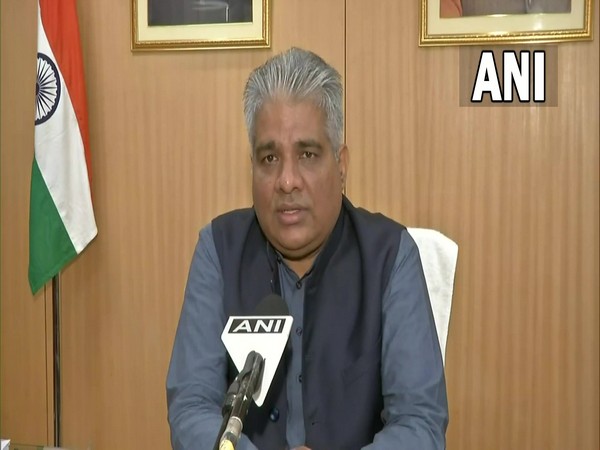
Reducing consumption and forming a self-restrained society is the only way to live with nature harmoniously, Union Environment Minister Bhupender Yadav said on Tuesday. Releasing the Centre for Science and Environment's (CSE) State of India's Environment Report, 2022, the minister said the three critical issues that confront the nation are climate change, desertification and the sustainability-affordability linkage. The report was released at a conclave in Rajasthan's Nimli.
''Reducing consumption and forming a self-restrained society is the only way that we can live with nature harmoniously.
''We can change people's lives by linking affordability with sustainability. We have to link traditional knowledge with scientific temperament; we sometimes are so proud of traditional knowledge that we forget logic. But we have to think of logic and affordability along with tradition to make it work,'' he said. Yadav said his ministry is keen to have an ''open debate on environment.'' Referring to India's efforts to achieve net zero by 2070, Yadav pointed out that since emissions from the energy sector were the highest, the government was putting more emphasis on it. ''By 2030, we plan to have 500 GW from renewable energy. Railways will be electrified by 2030 -- that will reduce 80 billion tonne of emissions. We also plan to employ LED bulbs on a large scale, which can reduce 40 billion tonnes of emissions. ''We are also focussing on hydrogen. If we can make hydrogen sustainable and affordable, we can bring big changes in the world,'' he said.
Talking of global climate negotiations and India's position, the minister said negotiations ''is not about give and take – it is about saving humanity. The developed nations must take historic responsibility and consider what their ancestors have done in the past.'' Talking about the challenge of climate change, CSE Director General Sunita Narain said India needs to act in its own self-interest. ''Our climate change strategy has to be based on the principle of co-benefits. We will do something for climate change because it is good for the world, but also because it is good for us. We need a low-carbon strategy for every sector; we must also ask the developed world to pay for and give us the high-cost options so that we can leapfrog,'' she said.
In the last two years, the world has seen disruption at a scale not seen before, she added. ''Both COVID-19 and climate change are the result of our 'dystopian' relationship with nature -- call this the revenge of nature. COVID-19 because we are breaking the barrier between the wild habitats/humans and the way we produce our food. And climate change is the result of emissions needed for economic growth – fossil fuels are unsustainable; our lifestyle is the problem.
''Both are also linked, and are being exacerbated because of our mismanagement of health systems and the environment,'' she said.
The report covers wide range of environmental issues in India from climate change, sustainable development goals, habitats, waste, renewable energy, pandemic impact, rural development, forests and biodiversity spread across 13 chapters.


 Google News