

ESA's Solar Orbiter speeding towards historic first close pass of Sun
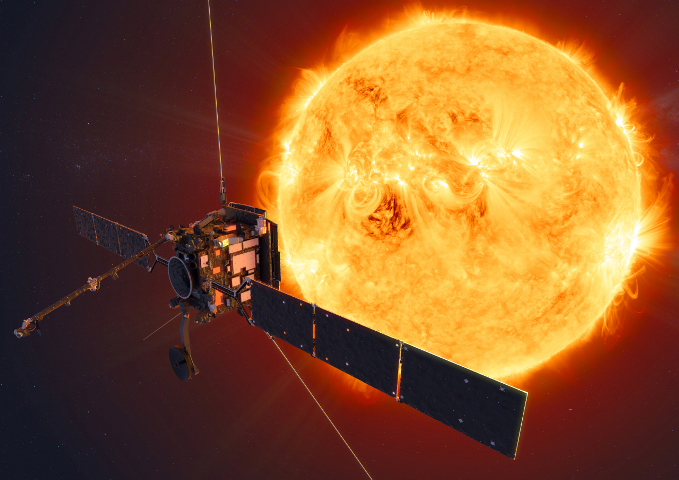
The ESA/NASA Solar Orbiter spacecraft is on its way to a historic first close pass of the Sun. According to the European Space Agency, the spacecraft will pass the orbit of Mercury on March 14 and will reach the closest approach to the Sun on 26th March, bringing it to one-third the Earth-Sun distance, about 50 million km.
From 14 March to 6 April, the Solar Orbiter will remain inside the orbit of Mercury. Around perihelion, the name for closest approach to the Sun, the spacecraft will bring high-resolution telescopes closer than ever before to the Sun.
Data and images gathered by the Solar Orbiter could reveal more information about the campfires, the omnipresent miniature eruptions that were captured by the Extreme Ultraviolet Imager (EUI) from the spacecraft's first perihelion.
Solar Orbiter will use its remote sensing instruments and in-situ instruments to image the sun and to measure the solar wind, which could reveal more information about the omnipresent miniature solar flares dubbed campfires.
The 26 March perihelion passage is one of the major events in the mission aimed at unravelling the mysteries of our life-giving star.
"What I'm most looking forward to is finding out whether all these dynamical features we see in the Extreme Ultraviolet Imager (coined campfires) can make their way into the solar wind or not. There are so many of them," says Louise Harra, co-Principal Investigator for EUI based at the Physikalisch-Meteorologisches Observatorium Davos/World Radiation Center (PMOD/WRC), Switzerland.
Launched on 10 February 2020, Solar Orbiter carries six remote-sensing instruments that image the Sun and its surroundings and four in situ instruments that monitor the environment around the spacecraft.
Last month, the spacecraft captured a giant solar eruption that extended millions of kilometres into space. The eruption was captured by the Full Sun Imager (FSI) of the EUI onboard the spacecraft.
Towards the Sun we go! @esasolarorbiter is crossing the Earth-Sun line today, on its way to a close solar approach that will bring it to one-third the Earth-Sun distance, about 50 million km, on 26 March. See more👉 https://t.co/RTkwnRxgKT #ExploreFarther #WeAreAllSolarOrbiters pic.twitter.com/ONANEN5FLQ
— ESA Science (@esascience) March 7, 2022


 Google News