



Webb telescope captures galaxy IC 5332 in unprecedented detail
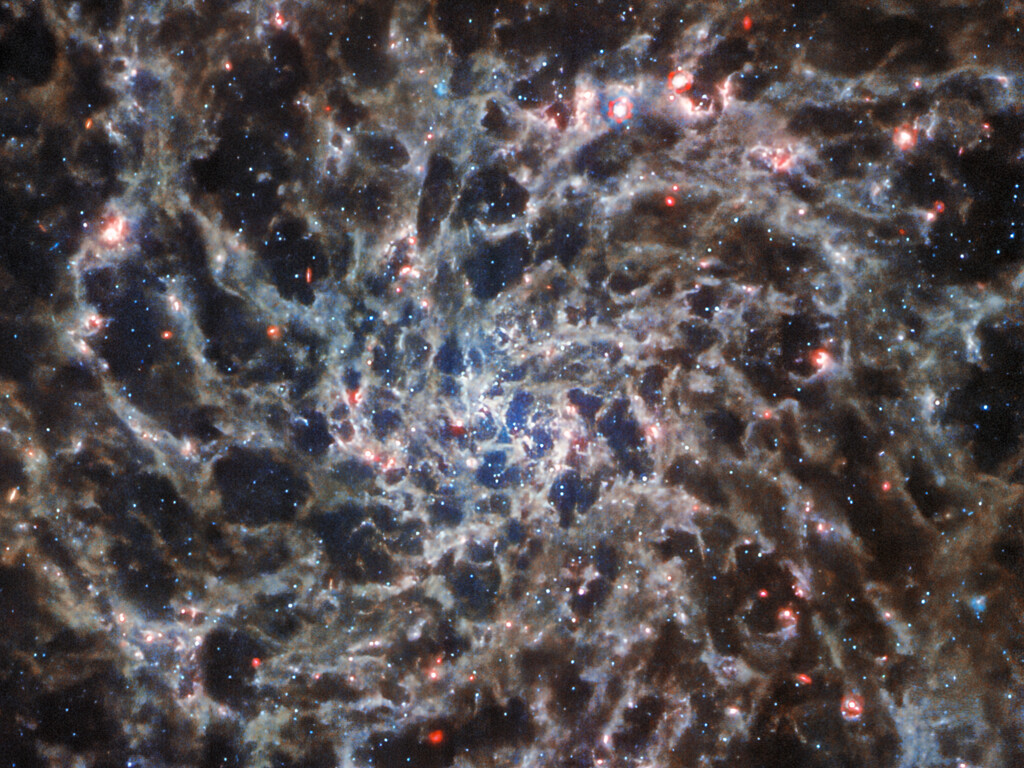
The Mid-InfraRed Instrument (MIRI) mounted on the NASA/ESA/CSA James Webb Space Telescope has captured this spectacular image featuring IC 5332, a spiral galaxy that lies over 29 million light-years from Earth, and has a diameter of roughly 66 000 light-years - a little larger than our Milky Way galaxy.
MIRI is the only Webb instrument that is sensitive to the mid-infrared region of the electromagnetic spectrum. The mid-infrared is incredibly difficult to observe from Earth as much of it is absorbed by Earth's atmosphere, and heat from Earth's atmosphere further complicates things.
To observe the universe in mid-infrared, MIRI must be kept more than 30 degrees cooler than the other instruments in the Webb observatory. The instrument operates at the frosty temperature of -266 degrees Celsius, which is barely seven degrees above absolute zero.
"Hubble could not observe the mid-infrared region as its mirrors were not cool enough, meaning that infrared radiation from the mirrors themselves would have dominated any attempted observations. The extra effort made to ensure that MIRI's detectors had the freezing environment necessary to operate properly is evident in this stunning image," the European Space Agency said in a statement.
Hubble vs Webb observations of IC 5332
While the Hubble image shows dark regions between the spiral arms, Webb's image shows a continual tangle of structures that echo the spiral arms’ shape. This is due to dusty regions in the galaxy.
 Hubble (L); Webb (R)
Dusty regions show up dark in Hubble's image as ultraviolet and visible light are far more prone to being scattered by interstellar dust than infrared light. The same dusty regions are not obvious in Webb's image, as the mid-infrared light from the galaxy has been able to pass through them, according to ESA.
Despite the difference, the Webb and Hubble images complement one another in a remarkable way, each revealing more about IC 5332's structure and composition.
Great comparison of images of galaxy IC5332 by the NASA/ESA @HUBBLE_space Telescope and the NASA/ESA/CSA James #Webb Space Telescope 👇 #JWST https://t.co/REKpv61MMp pic.twitter.com/ZxxPIEmPQA
— ESA (@esa) September 27, 2022


 Google News