

NASA completes key certification tests for production of new RS-25 Artemis engines
- Country:
- United States
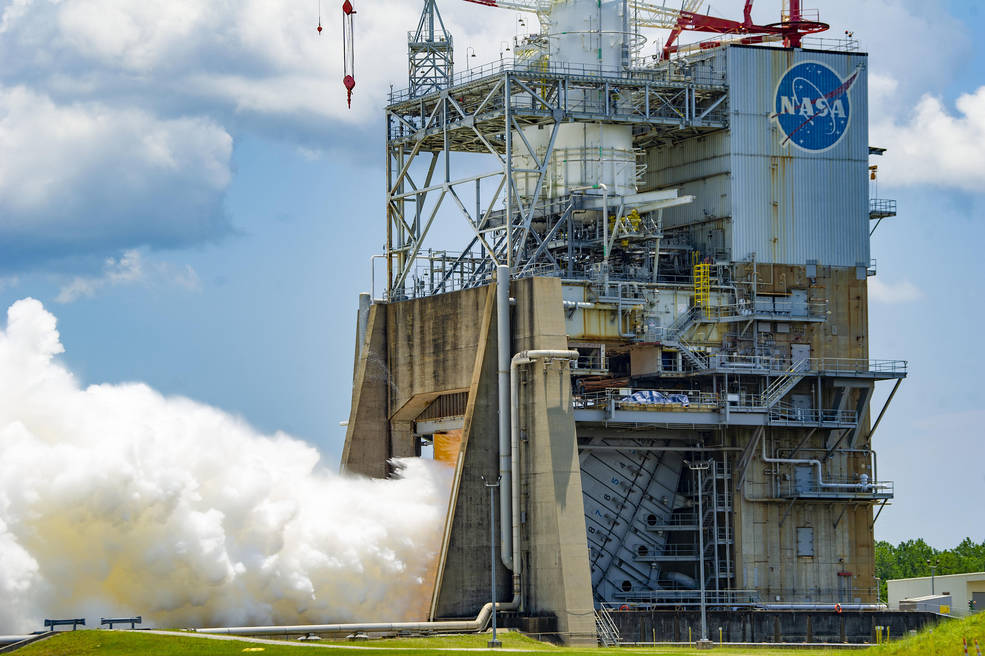
NASA achieved a significant milestone on June 22, marking the completion of an initial certification test series that paves the way for the production of the new RS-25 engines to power the agency's Space Launch System (SLS) rocket on future Artemis missions to the Moon, starting with Artemis V.
The newly redesigned RS-25 engines incorporate numerous improvements aimed at enhancing production efficiency and affordability without compromising performance.
The successful test series, conducted on a certification engine manufactured by Aerojet Rocketdyne, demonstrated the engine's high performance, reliability, and adherence to all Artemis flight requirements. It provided key data about the performance limits of the redesigned engine and components.
NASA engineers conducted a full-duration test lasting more than eight minutes (500 seconds) on the RS-25 certification engine. It took place on the Fred Haise Test Stand at NASA's Stennis Space Center in south Mississippi.
With this milestone achieved, the stage is now set for the second and final certification series, scheduled to begin in early fall. The data gathered from these tests will serve as confirmation that the engines are ready for production, ensuring a smooth transition into the Artemis V mission and subsequent lunar exploration endeavours.
In a press release, NASA said that Aerojet Rocketdyne, the lead contractor for SLS engines, is implementing innovative manufacturing processes and techniques, including 3D printing, to streamline the production of RS-25 engines. The agency has awarded the company contracts for the production of 24 new engines, which will power a total of six SLS launches. During each launch, four RS-25 engines will fire simultaneously, generating over 2 million pounds of combined thrust to propel the rocket into space.
"Testing new hardware always is a learning process, even on an engine as proven as the RS-25. The success of this series really is a testament to NASA's commitment to 'test as we fly' and to the expertise of the test team," said Chip Ellis, manager of the RS-25 Engine Test Project at NASA Stennis.
The second certification series, upon completion, is expected to provide the final green light for engine production, enabling future Artemis missions to the Moon and, eventually, Mars.
With a series of increasingly complex Artemis missions, NASA aims to establish sustainable lunar exploration and utilize the Moon as a stepping stone for deep space missions, paving the way for humanity's future in space.
#ICYMI: On June 22, @NASAStennis conducted the final RS-25 hot fire test in a certification test series designed to pave the way for the production of new RS-25 engines for future flights of #NASASLS, beginning with #Artemis V.READ MORE >> https://t.co/kABTodywjK pic.twitter.com/e9tvrbpwjy
— NASA_SLS (@NASA_SLS) June 24, 2023


 Google News