

Funding the Future: Policy Samvad Hosts Workshop on Tribal Welfare and Finance
The Guest of Honour, Shri Nirupam Chakma, Member of the NCST, stressed the importance of an equitable financial framework for the holistic development of tribal populations.
- Country:
- Bhutan
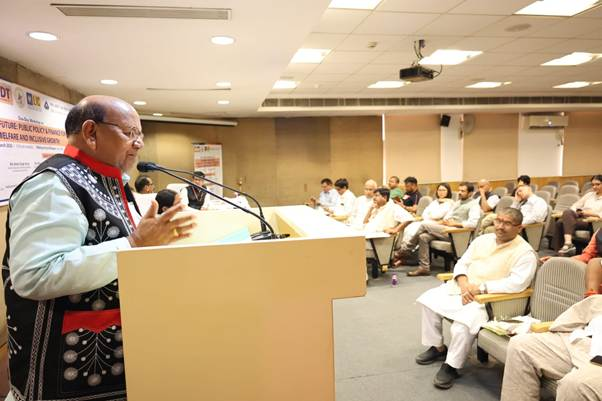
In a significant initiative aimed at advancing public policy discussions on tribal welfare and inclusive growth, Policy Samvad, in collaboration with the Institute for Public Research and Development Trust (IPPRDT) and the Mahamana Madan Mohan Malviya Memorial Trust, organized a one-day workshop titled "Funding the Future: Public Policy and Finance for Tribal Welfare and Inclusive Growth." The event was held at Malviya Smriti Bhawan, New Delhi, bringing together policymakers, domain experts, and stakeholders to deliberate on key issues surrounding public finance and tribal welfare.
Inaugural Session: Setting the Tone for Tribal Welfare Discussions
The workshop commenced with an inaugural session led by Gaurav Kumar, Editor of Policy Samvad and a well-regarded Public Policy Analyst, who welcomed the guests and provided a thematic overview of the workshop. He emphasized the importance of fostering constructive dialogue and collaboration to promote policy solutions for tribal welfare.
The Chief Guest of the event, Shri Antar Singh Arya, Chairman of the National Commission for Scheduled Tribes (NCST), delivered an insightful keynote address. He lauded Policy Samvad's role in facilitating public discourse on governance and policy research, particularly concerning tribal welfare. Shri Arya also elaborated on the initiatives outlined in the current Union Budget, highlighting the Central Government's commitment to inclusive development for tribal communities.
The Guest of Honour, Shri Nirupam Chakma, Member of the NCST, stressed the importance of an equitable financial framework for the holistic development of tribal populations. He underlined the need for efficient management of public finance to bridge socio-economic disparities.
Former Acting Chairperson and Member of the National Human Rights Commission (NHRC), Smt. Vijaya Bharati Sayani, shared her perspectives on human rights and policy frameworks aimed at empowering tribal communities.
Additionally, Shri Harishankar Singh, National President of the Mahamana Malviya Mission, spoke on the evolving role of public policy in fostering sustainable development among tribal communities. Shri Amit Nirmal, Joint Secretary of the NCST, provided a bureaucratic perspective on policy implementation and financial allocations directed at tribal welfare.
Panel Discussions and Expert Contributions
The workshop featured a series of high-level discussions, providing a platform for domain experts, policymakers, and researchers to exchange ideas and explore new avenues for effective policy interventions. Several esteemed speakers contributed to these discussions, including:
-
Dr. Prakash Chand Kandpal (Professor, Jawaharlal Nehru University) – Delivered insights into tribal socio-economic indicators and their policy implications.
-
Prof. Pavanesh Kumar (IGNOU) – Discussed the role of education and skill development in tribal empowerment.
-
Shri Chakshu Roy (PRS Legislative Research) – Highlighted the legislative mechanisms shaping tribal welfare policies.
-
Shri Vinay Kumar Singh (Senior Fellow, Dr. Shyama Prasad Mukherjee Foundation) – Spoke on public finance reforms and their impact on marginalized communities.
-
Shri A K Choubey (General Secretary, Bharatiya Adivasi Sevak Sangh) – Addressed grassroots challenges faced by tribal communities.
-
Shri Prakash Uikey (Former Judge) – Discussed legal safeguards and judicial perspectives on tribal rights.
-
Dr. Abhishek Srivastava (Assistant Professor, JNU) – Analyzed policy gaps and suggested measures for effective governance.
The deliberations underscored the significance of aligning financial policies with the unique needs of tribal communities, emphasizing grassroots participation and sustainable development strategies.
Policy Samvad Journal Release: A Scholarly Contribution to Policy Discourse
One of the key highlights of the event was the release of the tenth issue of Policy Samvad, unveiled by the Chief Guest and distinguished invitees. The journal, curated by an advisory board comprising eminent professors and policy analysts, serves as a crucial platform for intellectual discourse on governance, socio-economic development, and policy interventions, including NITI Aayog's initiatives. The latest issue focuses on contemporary challenges and opportunities in tribal welfare and inclusive growth.
Engaging the Next Generation: Participation from Scholars and Researchers
The workshop witnessed active participation from scholars, university students, and public policy professionals, including representatives from PRS Legislative Research and other policy think tanks. Attendees engaged in stimulating discussions, contributing fresh perspectives on the future trajectory of tribal development in India.
Conclusion: A Step Toward Inclusive Policy Making
The event concluded with a comprehensive address by Dr. Praveen Kumar Jha, who summarized the key takeaways and emphasized the need for sustained dialogue and collaboration among policymakers, researchers, and community representatives. He reiterated the importance of leveraging public finance to drive inclusive growth and social equity.
The workshop reinforced Policy Samvad's commitment to fostering evidence-based policymaking and ensuring that the discourse on tribal welfare remains at the forefront of India's development agenda. By bringing together stakeholders from various domains, the event successfully laid the groundwork for actionable policy recommendations aimed at empowering tribal communities and advancing inclusive growth in the country.


 Google News