

There Is No Visualisation in the Constitution of Any Authority above Parliament, Asserts VP
Shri Dhankhar issued a clarion call to the youth, urging them to elevate themselves above partisan divides and embrace national interests.
- Country:
- India
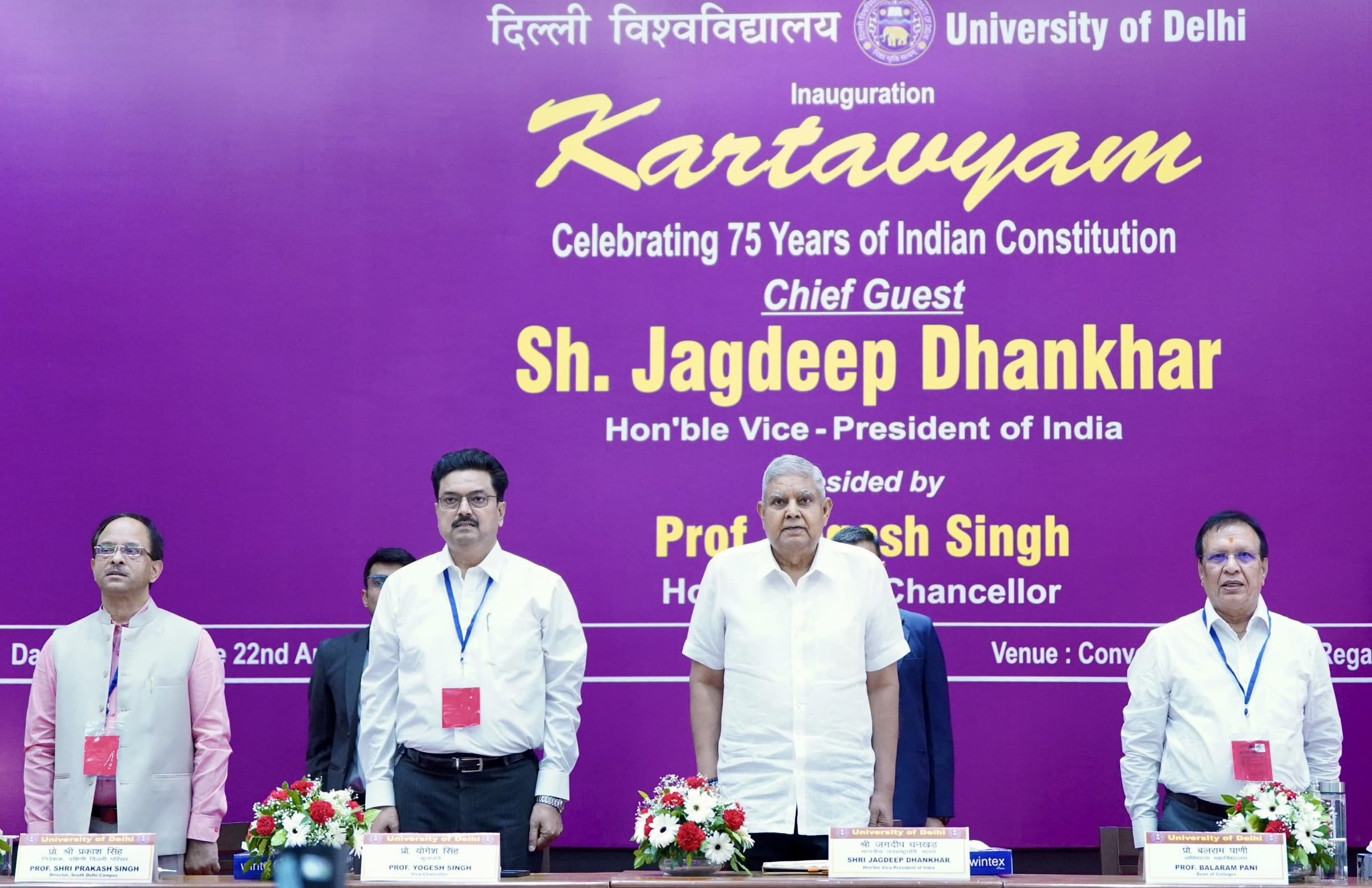
In a powerful address that echoed the foundational principles of Indian democracy, the Hon'ble Vice-President of India, Shri Jagdeep Dhankhar, underscored the indispensable role of citizens, participatory governance, and the vitality of dialogue at the 'Kartavyam' event commemorating 75 years of the Indian Constitution. Held at the University of Delhi, the event brought together esteemed academicians, students, and dignitaries, with the Vice-President presiding as Chief Guest and ex-officio Chancellor of the University.
Democracy Rooted in the Citizenry
In his keynote speech, Shri Dhankhar affirmed that every citizen is the cornerstone of India's democratic structure, rejecting the notion that constitutional offices are merely ceremonial. "It is inconceivably intriguing that some suggest constitutional roles are ornamental. Nothing could be further from the truth. Democracy blossoms when citizens are alert and engaged," he remarked.
He equated citizenship to atomic energy, emphasizing that each individual—akin to an atom—possesses immense power that is activated during elections. "Democracy's soul resides in every citizen. No one, no authority, is above the people of India," he stressed.
Parliament and the Preamble: Pillars of the Constitution
Referring to the Preamble of the Constitution as its distilled essence, the Vice-President reiterated that supreme power rests with the people, who express their collective will through elected representatives. "The Constitution is not a relic; it is a living document powered by the people. Elections serve as the ultimate instrument of accountability," he said, referencing the public's verdict against the Emergency regime in 1977.
Shri Dhankhar reminded the audience that Parliament is not above the people—it is of the people, and that democracy must be shaped by those it serves.
Participatory Democracy Beyond Governance
Highlighting the participatory nature of democracy, Shri Dhankhar said, "Democracy is not just for governments to govern. It's a culture, an ethos—a shared responsibility." He invoked the analogy of a football field, saying, "The government provides the stadium, but goals must be scored by individuals."
He emphasized that democracy demands action from every citizen, urging them to defend national sovereignty, preserve heritage, and foster unity. "Citizenship is not a status. It's a dynamic responsibility," he declared.
Dialogue and Expression: The Lifeblood of Democracy
A significant part of his address revolved around the importance of discourse in gauging the health of democracy. "To understand the strength of our democracy, observe the quality of our discourse. Is it driven by reason or manipulated by moneybags and muscle power?" he asked.
He elaborated on the core democratic values of expression (Abhivyakti) and dialogue (Samvaad), warning against arrogance and suppression of dissent. "Freedom of speech must coexist with the willingness to listen and respect differing views. True expression is never egotistical. Dialogue is essential," he said.
Citing India's ancient tradition of 'Anantavad' (infinite perspectives) and 'Vaad-Vivaad' (reasoned debate), he said these civilizational values continue to be relevant. "Healthy debate dissolves ego. Arrogance not only corrupts individuals but also damages institutions," he stated.
Empowering the Youth: The Vanguard of Nation-Building
Shri Dhankhar issued a clarion call to the youth, urging them to elevate themselves above partisan divides and embrace national interests. "Bharat is on the rise—unstoppably so. Our youth must rise to this occasion, not be swayed by ideological factions. We are destined to be a global power, and you are the architects of this future," he declared.
He encouraged young minds to channel their energies into thoughtful deliberation and inclusive nation-building, as India continues its transformative journey toward becoming a developed nation.
Event Highlights and Dignitaries Present
The event, hosted at the University of Delhi's South Campus, was attended by prominent university officials, including:
-
Shri Yogesh Singh, Vice-Chancellor, University of Delhi
-
Prof. Balaram Pani, Dean of Colleges
-
Shri Prakash Singh, Director, South Delhi Campus
They echoed the Vice-President's sentiments and highlighted the University's commitment to fostering constitutional values and civic responsibility in students.
The Vice-President's impassioned address served as a stirring reminder of India's democratic ethos, grounded in citizen empowerment, civil discourse, and the unassailable power of collective will. As the nation marks 75 years of its Constitution, his words reaffirm the timeless relevance of its Preamble and the unbreakable link between governance and the governed.


 Google News