

Europe's Gaia mission to reveal new details about nearly two billion objects in our galaxy
- Country:
- France
On 13 June, the European Space Agency will release the Gaia mission's third full data set which contains new and improved details for almost two billion objects in our home galaxy - the Milky Way. A subset of Gaia's third data set was released in December 2020.
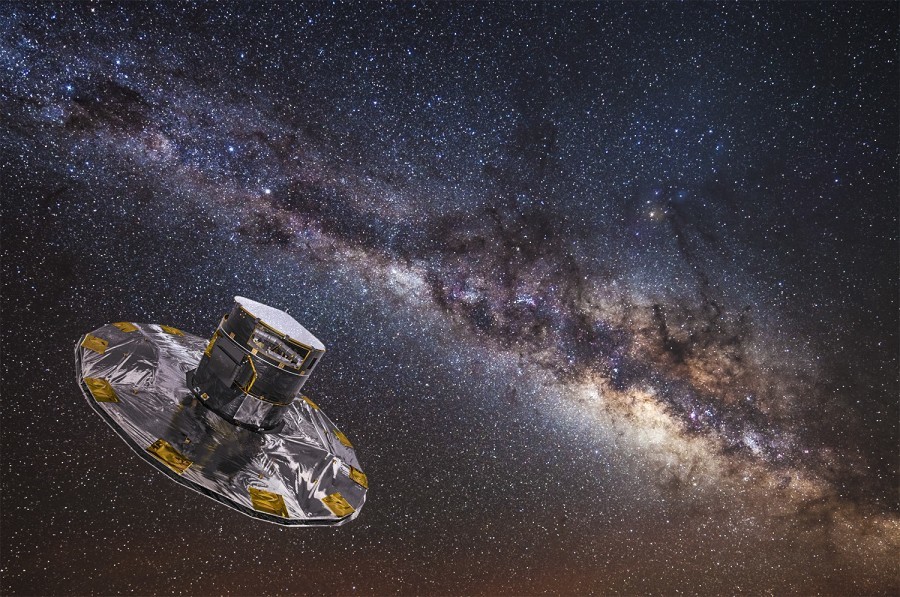
Launched in 2013, Gaia, short for the Global Astrometric Interferometer for Astrophysics, is a European mission to create the most accurate and complete multi-dimensional map of the Milky Way by surveying about 1% of the galaxy's 100 billion stars.
ESA Gaia's data release 3, based on observations from 25 July 2014 and 28 May 2017, will be made public on 13 June, at 10:00 CEST. The new release includes radial velocities for 33 million stars, the largest-ever low-resolution spectroscopy survey, the first space-based all-sky survey of quasars and of the shape of galaxies in the Local Universe and a photometric survey of the Andromeda Galaxy, among others.
The data set will provide astronomers with an unprecedented view of stellar characteristics and their life cycle, and the galaxy's structure and evolution, the agency said.
On 13 June, @ESAGaia will release a wealth of new data about our Milky Way. But how does @ESAGaia study the galaxy? Learn about this and more in our new media kit 👉https://t.co/RPUWfwWjow #GaiaDR3 #GaiaMission #GaiaScience pic.twitter.com/tN6cB4freZ
— ESA Science (@esascience) June 6, 2022
Gaia operates around the L2 point of the Sun-Earth system, which is located 1.5 million km from the Earth in the anti-Sun direction. In addition to mapping stars in our home galaxy, the spacecraft carries out observations of known asteroids within our solar system, providing data on the orbits and physical properties of these bodies.
The first and second data sets from ESA's Gaia mission were released in 2016 and 2018, respectively. They contained stellar positions, distances, motions across the sky, and colour information, among others.


 Google News