

Alarming: NASA detects 2020 FK, FS, DP4, FF1 asteroids approaching Earth this weekend
- Country:
- Australia
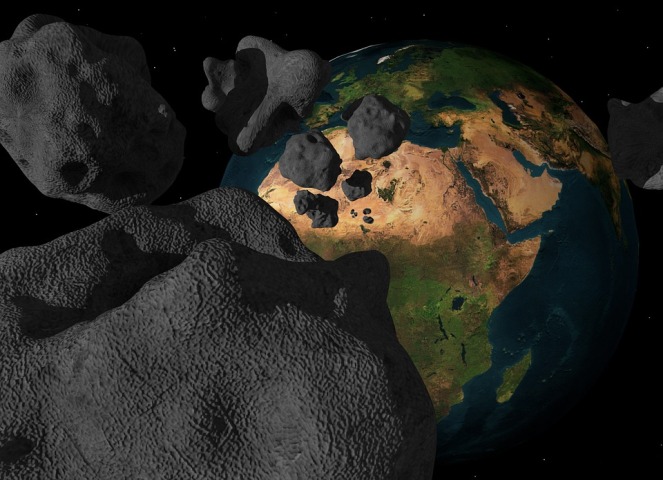
The National Aeronautics and Space Administration aka NASA has recently detected 4 asteroids approaching towards Earth.
According to the sources, NASA has found 4 asteroids that are likely to hit the planet Earth this weekend. IBT noted that the biggest asteroid in the group is around as big as Italy's Leaning Tower of Pisa.
The first asteroid, which is likely to hit Earth this weekend, has been identified as 2020 FK by NASA's Center for Near-Earth Object Studies (CNEOS). The diameter of this asteroid is around 43 feet that makes it smallest in the group. If sources are to be believed, this asteroid is currently travelling at a velocity of more than 23,000 miles per hour.
Another asteroid named by CNEOS is 2020 FS. This asteroid is trailing behind 2020 FK. The 2020 FS asteroid is currently flying at a velocity of around 9,600 miles per hour. According to the space researchers, the direction of its flow in the space is towards Earth. This asteroid measures around 56 feet wide.
According to IBT, both 2020 FS and 2020 FK asteroids will approach the Earth's vicinity on Saturday, March 21, 2020. While 2020FS is likely to approach Earth at 11:29 am EDT, 2020 FK may visit the planet's vicinity on the same day at 12:05 am EDT. During the approach, 2020 FK and 2020 FS asteroids will approach the Earth from a distance of around 0.00909 astronomical units (or about 845,000 miles away) and around 0.02096 astronomical units (about 1.9 million miles) respectively.
Here's not the end. Sunday, March 22 is likely to witness the approaching of another two asteroids – 2020 DP4 and 2020 FF1. The 2020 DP4 asteroid having a diameter of 180 feet is currently moving across the solar system at a speed of 18,000 miles per hour and 2020 FF1 (49 feet wide) is moving towards the planet at a speed of around 29,000 miles per hour.
Just for having an overview, the similar incident took place on February 15, 2013 when the Chelyabinsk meteor entered Earth's atmosphere over Russia with a speed of 42,900 miles per hour. It quickly became a brilliant superbolide meteor over the southern Ural region. The light from the meteor was brighter than the Sun. It was observed over a wide area of the region and in neighbouring republics. Some eyewitnesses also felt intense heat from the fireball.
The object exploded in an air burst over Chelyabinsk Oblast in Russia due to its high speed and shallow angle of atmospheric entry at a height of about 97,000 ft. The explosion generated a bright flash, producing a hot cloud of dust and gas that penetrated to 26.2 km and many surviving small fragmentary meteorites, as well as a large shock wave.


 Google News