

USGS releases first-ever comprehensive geologic map of the Moon
Have you ever wondered what kind of rocks make up those bright and dark splotches on the moon? Well, the USGS has just released a new authoritative map to help explain the 4.5-billion-year-old history of our nearest neighbour in space.
- Country:
- United States
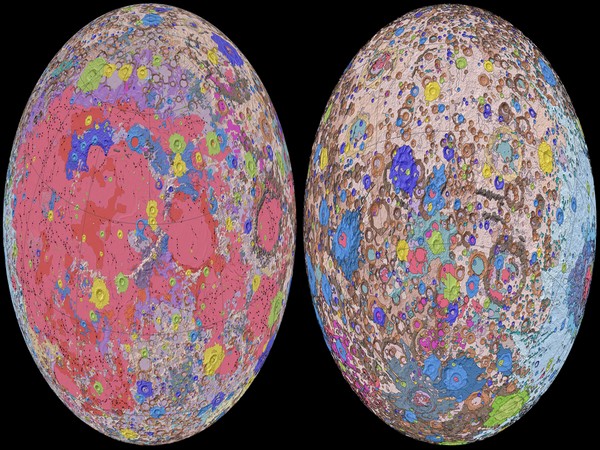
Have you ever wondered what kind of rocks make up those bright and dark splotches on the moon? Well, the USGS has just released a new authoritative map to help explain the 4.5-billion-year-old history of our nearest neighbour in space. This animation shows a rotating globe of the new Unified Geologic Map of the Moon with shaded topography from the Lunar Orbiter Laser Altimeter (LOLA). This geologic map is a synthesis of six Apollo-era regional geologic maps, updated based on data from recent satellite missions. It will serve as a reference for lunar science and future human missions to the Moon.
For the first time, the entire lunar surface has been completely mapped and uniformly classified by scientists from the USGS Astrogeology Science Center, in collaboration with NASA and the Lunar Planetary Institute. The lunar map, called the "Unified Geologic Map of the Moon," will serve as the definitive blueprint of the moon's surface geology for future human missions and will be invaluable for the international scientific community, educators and the public-at-large. The digital map is available online now and shows the moon's geology in incredible detail (1:5,000,000 scale).
"People have always been fascinated by the moon and when we might return," said current USGS Director and former NASA astronaut Jim Reilly. "So, it's wonderful to see USGS create a resource that can help NASA with their planning for future missions." To create the new digital map, scientists used information from six Apollo-era regional maps along with updated information from recent satellite missions to the moon. The existing historical maps were redrawn to align them with the modern data sets, thus preserving previous observations and interpretations. Along with merging new and old data, USGS researchers also developed a unified description of the stratigraphy, or rock layers, of the moon. This resolved issues from previous maps where rock names, descriptions and ages were sometimes inconsistent.
"This map is a culmination of a decades-long project," said Corey Fortezzo, USGS geologist and lead author. "It provides vital information for new scientific studies by connecting the exploration of specific sites on the moon with the rest of the lunar surface." Elevation data for the moon's equatorial region came from stereo observations collected by the Terrain Camera on the recent SELENE (Selenological and Engineering Explorer) mission led by JAXA, the Japan Aerospace Exploration Agency. Topography for the north and south poles was supplemented with NASA's Lunar Orbiter Laser Altimeter data. (ANI)


 Google News