

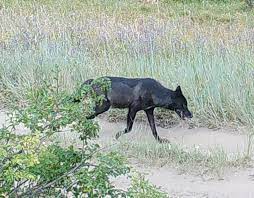
Black colour of North American wolves' coat a measure of disease resistance: Study
This is because the DNA region containing the gene also encodes for a protein that plays a role in defending against infections in the lungs of mammals.They predicted that having a black coat would be associated with the ability of wolves to survive an infection with CDV.To test this idea, the researchers analysed 12 wolf populations from North America, to examine whether the probability of a wolf being black was predicted by the presence of CDV antibodies.If a wolf has CDV antibodies, then it has caught CDV in the past and survived.
- Country:
- United States
Scientists may have finally uncovered why wolves change colour across the North Atlantic continent.
If you were to travel from Arctic Canada and head south down the Rocky Mountains into the US toward Mexico, the further south you go, the more black wolves there are. According to a group of scientists from University of Oxford, Yellowstone National Park, and Penn State, the reasons for this have long puzzled scientists.
''In most parts of the world, black wolves are absent or very rare, yet in North America they are common in some areas and absent in others.
''Scientists have long wondered why. We now have an explanation based on wolf surveys across North America, and modelling motivated by extraordinary data collected by co-authors who work in Yellowstone,'' said lead researcher Tim Coulson.
Coat colour in wolves (Canis lupus) is determined by a gene called CPD103. Depending on the variant of the gene a wolf has, its coat can either be black or grey.
The researchers, whose study has been published in the journal Science, has been postulated that this gene also plays a role in protecting against respiratory diseases such as canine distemper virus (CDV). This is because the DNA region containing the gene also encodes for a protein that plays a role in defending against infections in the lungs of mammals.
They predicted that having a black coat would be associated with the ability of wolves to survive an infection with CDV.
To test this idea, the researchers analysed 12 wolf populations from North America, to examine whether the probability of a wolf being black was predicted by the presence of CDV antibodies.
If a wolf has CDV antibodies, then it has caught CDV in the past and survived. They found that wolves with CDV antibodies were more likely to be black than grey. They also found that black wolves were more common in areas where CDV outbreaks occurred.
The researchers analysed over 20 years-worth of data from the wolf population at Yellowstone National Park. They found that black wolves were more likely to survive CDV outbreaks compared with grey wolves, according to the study.
These results led them to hypothesise that in areas where distemper outbreaks occur, wolves should choose mates of the opposite coat colour to maximize the chance their cubs would have black coats.
The scientists used a simple mathematical model to test this idea. Excitingly for them, the predictions from their model closely matched the observations that black and grey wolves were more likely to pair in areas where CDV outbreaks are common. This competitive advantage is lost in areas where CDV outbreaks do not occur.
These results are consistent with the idea that the frequency of CDV outbreaks across North America is responsible for the distribution of black wolves, because having the gene for a black coat may also provide protection against the virus. It also explains why mating pairs in Yellowstone, where canine distemper outbreaks occur, tend to be black-grey.
Peter Hudson, Willaman Professor of Biology, Penn State said, ''It is intriguing that the gene for protection against CDV came from domestic dogs brought by the first humans entering North America, and the CDV disease virus emerged in North America many thousands of years later, once again from dogs.'' ''What I love about this study is how we have been able to bring together experts from so many fields and a range of approaches to show how disease can have remarkable impacts on wolf morphology and behaviour. We are learning that disease is a major evolutionary driver that impacts so many aspect aspects of animal populations,'' said Hudson.
The researchers speculate that other species may follow a similar pattern to wolves. Many insects, amphibians, birds and nonhuman mammals have associations between colour and disease resistance. It might be, they claim, that the presence of a disease, or how frequently a disease outbreak occurs, is an important factor affecting the colour of mate an animal prefers.


 Google News