

IIT Guwahati Pioneers Eco-Friendly Method for C-Phycocyanin Commercialization
IIT Guwahati has partnered with K.N. Bioscience to commercialize their cost-effective, sustainable technology for extracting C-Phycocyanin from Spirulina. This collaboration aims to revolutionize industries by offering a natural alternative to synthetic dyes, boosting India's bioeconomy and establishing the nation as a key global exporter of microalgal products.
- Country:
- India
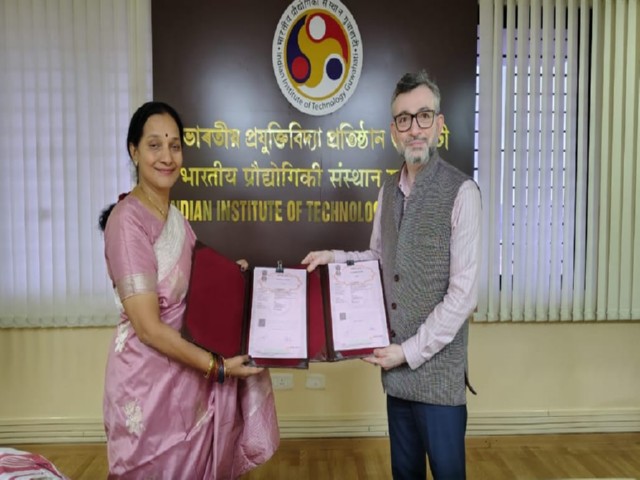
In a significant move towards the commercialization of sustainable biotechnological solutions, the Indian Institute of Technology (IIT) Guwahati has signed a Memorandum of Understanding with K.N. Bioscience (India) Pvt. Ltd. The partnership focuses on the large-scale commercialization of C-Phycocyanin production from Spirulina, a type of cyanobacteria. This agreement was formalized by Professor Rohit Sinha, Dean of Research & Development at IIT Guwahati, and Mrs. Sudha Reddy, Founder and Managing Director of K.N. Bioscience, in the presence of Professor Debasish Das, the lead scientist behind the innovative technology.
The collaboration aims to tackle economic and technological hurdles by providing a cost-effective and environmentally friendly method for extracting high-purity C-Phycocyanin. This pigment, derived naturally from Spirulina, offers various applications including use as a natural blue dye in food products, pharmaceuticals, diagnostics, and cosmetics. With IIT Guwahati's advanced technology, industries can now transition from synthetic additives to sustainable alternatives, boosting India's efforts towards self-reliance in biotechnology.
The project has demonstrated success in multiple experimental setups, including flask level experiments and pilot-scale trials. A patent has been granted on the innovative downstream process developed by IIT Guwahati researchers, marking a critical step towards large-scale production. With the Technology Readiness Level now at 6, this initiative is on the brink of commercial application, poised to make significant contributions to India's burgeoning bioeconomy and biomanufacturing landscape.


 Google News